
Why careful claim documentation pays off
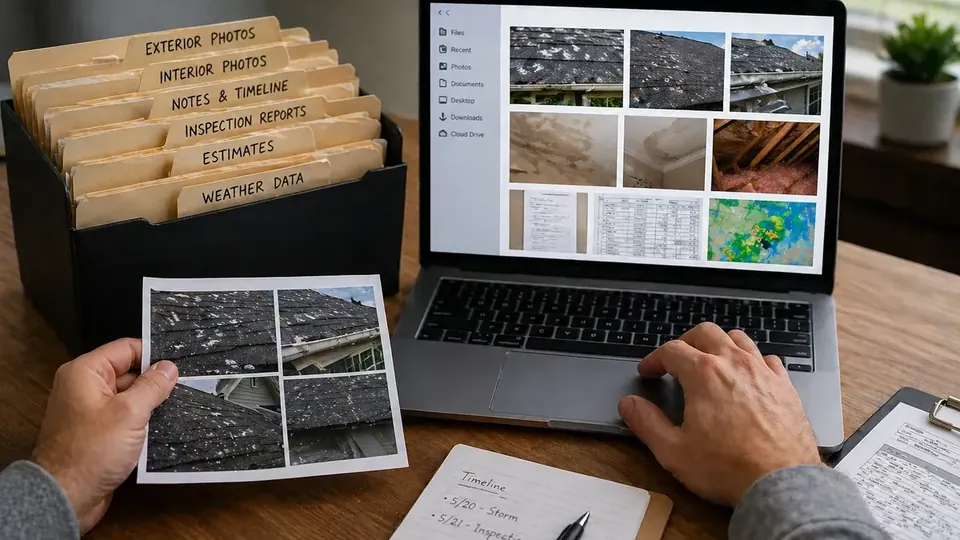
An insurer pays for what it can see and verify. The claim documentation checklist above is built around that simple fact: the more clearly you can show what was damaged, when it happened, and what it takes to fix it, the less room there is for disagreement later about the date of loss, old wear and tear, or items that never made it into the estimate.
The hard part is that evidence does not last. Rain washes hail marks off a roof, wet drywall gets torn out, and debris goes to the curb. In busy years the Hays County NOAA record fills up quickly (15 hail reports in 2024 alone), so dated photos also help tie damage to the right storm. Work through the list while the damage is still visible.
What to capture for common San Marcos losses
| Type of loss | Easy-to-miss evidence |
|---|---|
| Hail | Dents in gutters, downspouts, roof vents, window screens, AC condenser fins, and metal roofs or outbuildings; hailstones next to a coin or ruler |
| Wind | Creased or lifted shingles, missing ridge cap, displaced metal panels, fallen limbs, fence sections, and which side of the building took the hit |
| Water or freeze | The failed pipe or fitting, the shutoff location, moisture readings, the water line on walls, and the mitigation company’s drying logs |
| Fire and smoke | Soot in closets and HVAC returns, odor in soft goods, the fire department incident number, and damaged contents before disposal |
| Commercial | Inventory records, interrupted operations, rooftop equipment, and any business income or extra expense receipts |
Taking photos and video that help
- Shoot first, clean second. Photograph everything before moving it, then again after emergency mitigation.
- Use three distances. A wide shot to show where you are, a mid-range shot of the area, and close-ups of the damage itself.
- Add a scale reference. A coin, tape measure, or ruler beside hail, dents, or cracks makes size obvious.
- Circle the whole property. Capture every side of the house plus fences, sheds, carports, barns, and vehicles. Hail driven by wind often damages one elevation far more than the others.
- Narrate a walkthrough. Say the date, the address, and what you are looking at. Video ties individual photos together.
- Keep the originals. Do not crop or edit the original files; the embedded date and time can matter.
- Do not take risks. Stay off wet or damaged roofs and out of floodwater. Photograph from the ground and let a professional inspect the roof.
Setting up your claim file
Keep one folder, on paper or in the cloud, that you can reach from your phone. A simple structure:
- Policy documents: full policy, declarations page, endorsements, and any separate flood policy.
- Claim details: claim number, date of loss, and the names and contact details of every adjuster.
- Photos and video, sorted by date and area.
- Weather records: reports for your date of loss from the storm lookup tool or the recent weather events page.
- Estimates and receipts: contractor bids, the insurer’s estimate, mitigation invoices, permits, and hotel or meal receipts if you were displaced.
- Contents inventory: damaged belongings or business property with descriptions, ages, and costs where known.
- Correspondence: every letter, email, and text, plus your call log.
Keeping a claim communication log
Record every call, email, and visit: the date and time, the person’s name and role, what was said, and any next steps or deadlines. After an important phone call, send a short email confirming what was discussed. Texas prompt-payment rules give insurers set timeframes to acknowledge, investigate, and decide claims, and a clear log shows when each request and response really happened. That can be useful if your claim becomes delayed.
Your privacy
The checklist runs only in your browser. Your entries are not sent to us or anyone else. If you choose to save progress, it is stored in this browser’s local storage, so it will not follow you to another device and will disappear if you clear browser data. Use the print or download button to keep a copy with your claim file.
Want a second set of eyes on your file? A San Marcos public adjuster can review your documentation through a Free Claim Review, and our settlement calculator can help you read the insurer’s numbers once an estimate arrives.
Frequently Asked Questions
Does the checklist send my notes to anyone?
No. Checkmarks and notes stay in your browser. If you switch on “Save my progress,” they are kept in this browser’s local storage until you reset them or clear your browser data. Nothing is transmitted to us.
Can I start repairs before the insurance adjuster comes out?
Take reasonable steps right away to stop further damage, such as tarping an opening, shutting off the water, or bringing in a water-extraction company, and keep every receipt. Hold off on permanent repairs until the damage is documented and you have talked with your insurer, unless waiting would be unsafe. Photograph the damage before and after any emergency work.
How many photos is enough?
Take more than seems necessary. Get wide shots that show location, medium shots of each damaged area, and close-ups of the damage itself, plus a short narrated video. Photos cost nothing now and cannot be recreated once cleanup or repairs begin.
I already threw out damaged items. What now?
Write down what you discarded, when, and why, and collect anything that shows what the items were: photos, receipts, card statements, or online product listings. Let your insurer know. From here on, keep damaged items until the insurer says they can go, as long as keeping them is safe and sanitary.
Is flood damage part of my hail or wind claim?
Usually not. Standard homeowners and commercial policies generally exclude flood, so rising water from a creek, river, or street is typically handled under a separate NFIP or private flood policy. Rain that enters through a storm-damaged roof or window may be treated differently. Record exactly where the water came from and review both policies. Our flood damage claims page explains the difference.