

Wind damage insurance claims in San Marcos usually start the same way: a line of thunderstorms pushes through, gusts spike for a few minutes, and the next morning there are shingles in the yard, a fence leaning into the neighbor’s lot, or a limb through the porch roof. The damage can look obvious, yet wind claims are frequently underpaid or questioned because the insurer reads the evidence differently. As a San Marcos Public Adjuster serving Hays County, we help owners show clearly what the wind did and what it will cost to fix.
Damaging Wind in the San Marcos Area
NOAA’s Storm Events Database lists 109 thunderstorm wind reports in Hays County, with the most in May and June. Several of them describe exactly the type of damage that leads to insurance claims:
| Date | Location | What NOAA recorded |
|---|---|---|
| Jan 13, 2007 | San Marcos, along I-35 | Estimated 70–80 mph winds tore metal roofs off several buildings (record) |
| Jun 9, 2019 | San Marcos | About 75 mph gust partially peeled the metal roof off a house (record) |
| Jun 9, 2019 | Niederwald | About 80 mph gust blew a large section of roof off a house (record) |
| Jan 10, 2020 | Kyle | About 75 mph gusts blew siding off a house; multiple homes had shingle damage (record) |
| May 9, 2024 | San Marcos | About 70 mph gusts downed trees and damaged a church roof (record) |
Notice that two of those entries involve metal roofs. Exposed-fastener panels on Hill Country homes, shops, and barns can lift at the edges once a gust gets underneath, and once one panel moves the rest of the run is at risk. Our article on wind damage insurance claims in San Marcos covers more local history.
What We Document After a Windstorm
Wind leaves a pattern. Our inspection tries to capture that pattern so it is hard to dismiss as ordinary aging:
- Shingles: creased or torn tabs, broken seal strips, missing pieces, and exposed nail heads, mapped by slope and compass direction.
- Metal roofing: lifted panel edges, pulled or backed-out fasteners, bent trim, and displaced ridge caps.
- Exterior: stripped siding, torn soffit and fascia, bent gutters, damaged fences, carports, and outbuildings.
- Tree damage: where the tree or limb struck, what it broke, and photographs before removal when it is safe.
- Interior: ceiling stains, wet insulation, and damaged drywall connected to a specific opening in the roof or wall.
- Weather data: NOAA and NWS reports for the date, which you can begin researching with our storm lookup.
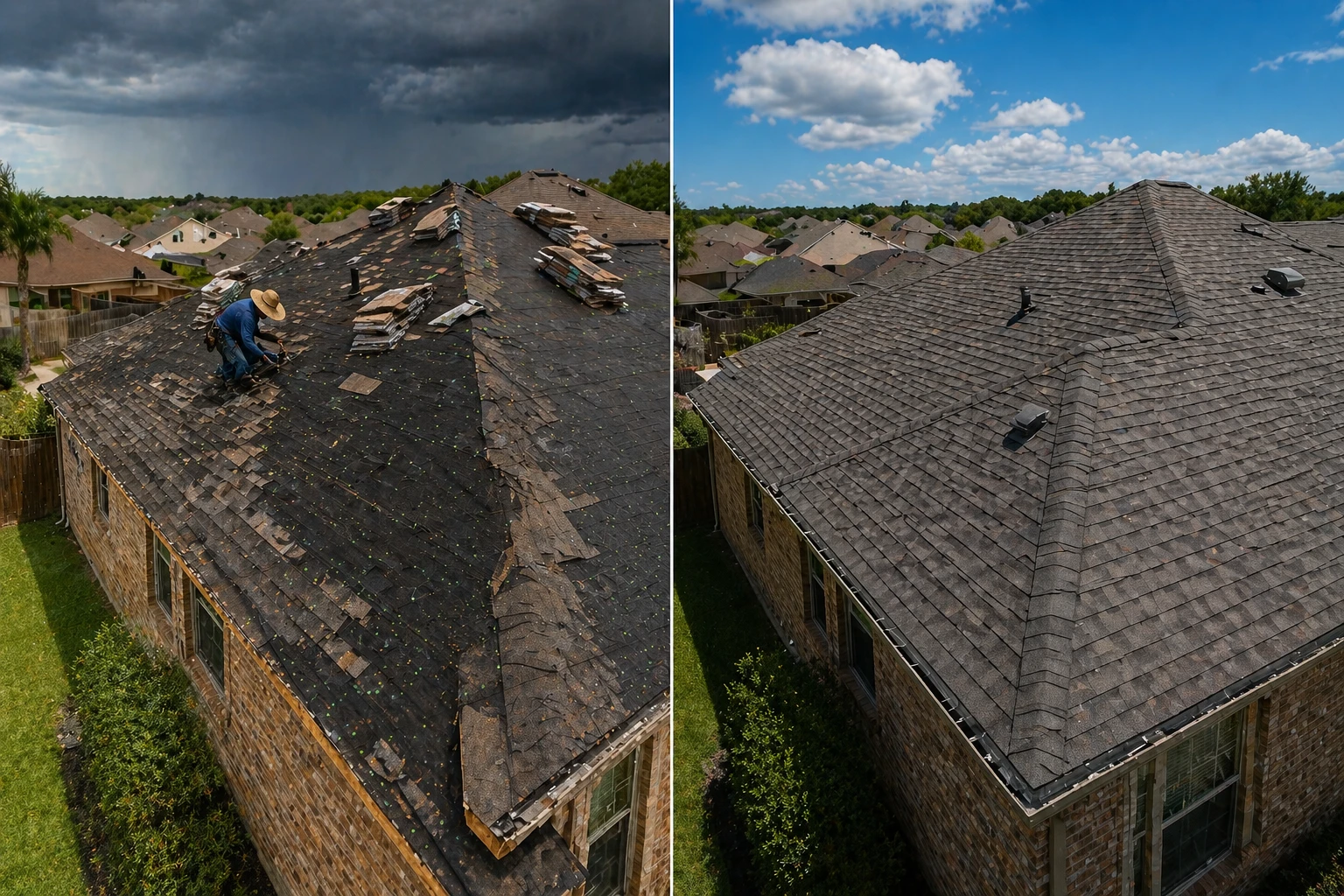
Where Wind Claims Run Into Trouble
“Wear and tear” denials
Older shingles lose their seal over time, and insurers sometimes argue a roof would have failed anyway. A directional damage pattern on the windward side, recent storm reports, and neighbors with similar damage all help counter that argument.
Wind-driven rain
Many policies limit interior water damage unless wind first created an opening. If the claim photos show a stained ceiling but not the missing shingle above it, the interior portion may be denied.
Partial roof scopes
Insurers may approve a handful of replacement shingles on a roof where the remaining shingles have also lost their seal. Whether a broader repair is supported depends on the inspection findings and the policy.
Deductibles and payment terms
Because Hays County is outside the TWIA area, wind coverage comes from your regular insurer, often with a percentage wind/hail deductible. Roof payment schedules or ACV-only roof coverage can also reduce the check. See our replacement cost versus ACV guide.
The First Few Days After a Windstorm
What you do right after the wind dies down can shape the claim for months. A few practical steps:
- Stay safe. Keep away from downed power lines and leaning trees, and let professionals handle anything on the roof.
- Photograph before cleanup. Capture loose shingles in the yard, panels hanging off a barn, a fence section on the ground, or a limb across the roof, with wide and close shots.
- Prevent further damage. Arrange tarping, board-up, or temporary fence repair to keep water and animals out. Save every receipt.
- Keep removed debris when practical. A torn panel or a handful of creased shingles can be useful evidence later.
- Write down the timeline. Note when the storm hit, what you heard or saw, and when you discovered each item of damage.
- Report the claim promptly and ask the insurer for the claim number and the adjuster’s contact information.
If neighbors on your street had similar damage, that is worth noting too. Wind damage that appears across several homes after the same storm is harder to explain away as age. Our claim documentation checklist has a printable list of what to collect.
How We Handle a Wind Damage Claim
- Free conversation and policy review, including your wind/hail deductible and any roof endorsements.
- Full property inspection: roof, exterior elevations, fences, outbuildings, and interior.
- Storm-date research and organized photo documentation.
- Line-item estimate and submission to the insurer.
- Meetings with the carrier’s adjuster, responses to requests, and supplements as repairs reveal more.
If you and the insurer agree the damage is covered but disagree on cost, appraisal may be available under the policy. Our insurance appraisal page explains how that works.
Wind Damage to Outbuildings, Fences, and Equipment
Properties west of I-35 toward Wimberley and Dripping Springs, and rural lots east toward Uhland and Maxwell, often include barns, shops, carports, and long runs of fencing. These structures are usually covered under the other structures portion of a homeowners policy, which has its own limit, or under separate coverage on a farm or commercial policy. They are also easy to leave out when the adjuster focuses on the house. We list each structure separately, with its own photos and line items, so nothing is folded into a single vague allowance. Exterior equipment such as AC condensers, satellite dishes, and solar panels can also be damaged by flying debris and should be checked after a strong storm.
When to Bring in a Public Adjuster
A public adjuster in San Marcos can be helpful when the insurer called the damage pre-existing, when interior water damage was excluded, when a metal roof or multiple buildings are involved, or when the approved amount does not come close to contractor bids. If hail fell in the same storm, see our hail damage claims page, and for multi-peril events see storm damage claims. Start with a free claim review and we will tell you honestly whether we think we can add value.
Frequently Asked Questions
Is wind damage in San Marcos covered by TWIA?
No. The Texas Windstorm Insurance Association covers designated coastal counties, and Hays County is not one of them. San Marcos properties typically get wind coverage from their regular homeowners or commercial insurer, or from the Texas FAIR Plan where applicable. Details are on TWIA’s website.
A tree fell on my house during a storm. Is that covered?
Damage to the house from a tree blown over by wind is commonly covered, subject to your deductible and policy terms. Removal of the tree itself may have a separate, smaller limit, and a tree that falls without damaging a covered structure may not be covered. Photograph the tree where it landed before removal when it is safe to do so.
Rain came in during the storm. Will my policy pay for the interior damage?
Many policies cover interior rain damage only when wind or hail first creates an opening in the roof or walls that lets the rain in. Documenting that opening, such as missing shingles or a torn soffit, is often what decides the interior portion of the claim.
How do I prove my shingles were damaged by wind and not age?
Creased or torn tabs, broken seal strips, missing shingles in a directional pattern, and damage concentrated on the windward side all point to a wind event. Pairing those photos with NOAA or NWS reports for your area on the storm date strengthens the case.
What if the insurer says my wind damage is below the deductible?
Ask for the insurer’s estimate in writing and compare it with a contractor or public adjuster estimate. Missing slopes, fences, gutters, or interior damage can change the total. If the gap is about the amount of loss rather than coverage, the policy’s appraisal clause may be an option.
Do I need a lawyer for a wind claim dispute?
Not necessarily, but public adjusters are not attorneys. Questions about lawsuits, bad faith, or the Chapter 542A pre-suit notice rules for weather claims should go to a Texas attorney.