
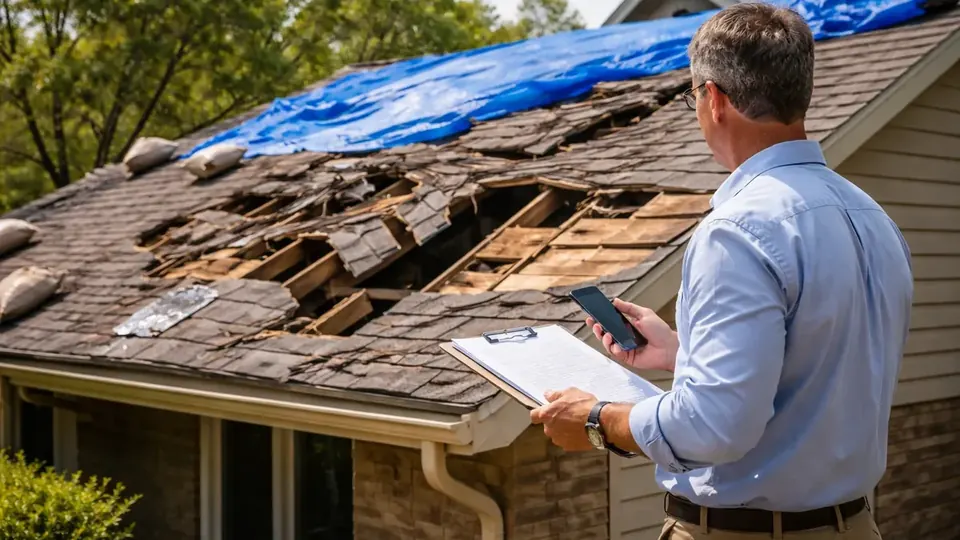
Property damage brings a pile of questions at once. Is it covered? What does my deductible really mean? Should I accept the first offer? Below are answers to the questions we hear most often as a San Marcos public adjuster. They are general information only: coverage always depends on your policy and the facts of your loss, and because we are not attorneys, legal questions should go to a Texas attorney.
What these FAQs cover
- Working with a public adjuster: what we do, fees, Texas contract rules, licensing, and timing
- Hail, wind, and storm claims in San Marcos: hail season, TWIA, deductibles, and first steps
- Flood, freeze, and water damage: flood exclusions, the NFIP, and burst pipes
- Denied, underpaid, and delayed claims: Texas Prompt Payment deadlines and appraisal
- Settlements and repairs: replacement cost vs. actual cash value and San Marcos building codes
Need more detail?
Most answers link to a deeper guide. You can also browse our claim services, read the insurance claim blog, or use the free claim tools. If your question is about your own claim, the quickest route is a Free Claim Review or a call to +1 (832) 503-5866.
Frequently Asked Questions
What does a public adjuster do?
A public adjuster is licensed to represent the policyholder, not the insurer, on a property insurance claim. The work usually includes inspecting the damage, reading the policy, preparing a detailed estimate and supporting documents, presenting the claim, and negotiating with the insurance company. In Texas, public adjusters are licensed by the Texas Department of Insurance under Insurance Code Chapter 4102. See what is a public adjuster and how to hire one.
Do I need a public adjuster for my claim?
Not always. Small, simple claims are often settled fairly without help. A San Marcos public adjuster is usually most useful when the loss is large or complicated, the claim was denied or underpaid, the insurer's estimate leaves out damage, or you do not have time to manage the process. Our guide do I need a public adjuster? walks through the decision.
How much does a public adjuster cost in Texas?
Fees are disclosed in a written contract before any work begins; Texas law caps public adjuster compensation at 10% of the insurance settlement. If the insurer pays, or commits in writing to pay, policy limits within 72 hours after the loss is reported, a percentage fee is not allowed. Our Free Claim Review costs nothing. For a closer look at value, read are public adjusters worth it?
Can I cancel a public adjuster contract after I sign it?
Yes. Texas public adjuster contracts must use terms approved by the Texas Department of Insurance, must let you rescind within 72 hours of signing, and must state "We represent the insured only."
How do I check that a public adjuster is licensed?
Use the license lookup on the Texas Department of Insurance website before you sign anything. San Marcos Public Adjuster is a public adjusting service of Rise Public Adjusting LLC, TDI license #3356839. More tips are in how to find a public adjuster.
Is a public adjuster the same as a lawyer or a roofing contractor?
No. A public adjuster handles the insurance claim. We do not give legal advice or file lawsuits, so questions about suits, bad faith, or deadlines to sue belong with a Texas attorney. Texas law also bars a public adjuster from taking part in repairing or rebuilding a property on a claim they adjust, so you choose your own contractor.
Is it too late to hire a public adjuster after the insurer has paid?
Not necessarily. Depending on the policy and the timing, a claim may be supplemented or reopened when damage was missed or the estimate was incomplete. Policy deadlines do apply, so do not wait. See when is it too late to hire a public adjuster? and insurance claim supplements.
When is hail season in San Marcos?
NOAA records for Hays County list 180 hail reports from 1967 through 2026, with the most in May (67) and April (57), followed by March. Damaging hail can still fall at other times of year. Recent examples include May 9, 2024, when hail up to 3 inches fell west of San Marcos, and May 22, 2025, when baseball-size hail was reported in Uhland. Read San Marcos hail season and storm data or try the storm lookup tool.
Does TWIA cover wind and hail damage in San Marcos?
Generally no. Hays County is not part of the Texas Windstorm Insurance Association catastrophe area, which covers certain coastal counties. San Marcos properties typically get wind and hail coverage from their regular property insurer, or from the Texas FAIR Plan where applicable.
What is a separate wind/hail deductible?
Many Texas policies apply a different deductible to wind and hail losses, often a percentage of the dwelling (Coverage A) limit rather than a flat dollar amount. A 1% or 2% deductible on a higher-value home can be several thousand dollars. Check your declarations page before you file so you know what to expect.
What should I do first after storm damage?
Make sure everyone is safe, then take photos and video of the damage before cleanup. Make reasonable temporary repairs, such as tarping a roof, to prevent more damage and keep receipts. Report the claim to your insurer promptly and write down your claim number and every conversation. Our claim documentation checklist helps you stay organized.
Does homeowners insurance cover flooding in San Marcos?
Standard homeowners and commercial property policies generally exclude flood. Flood coverage usually comes from the National Flood Insurance Program or a private flood policy, and NFIP policies typically have a 30-day waiting period. San Marcos participates in the NFIP, and new FEMA flood maps for the Blanco River, San Marcos River, and several creeks took effect January 17, 2025. Learn more at FloodSmart.gov or on our flood damage claims page.
Are burst pipes from a freeze covered?
Sudden and accidental water damage from a burst pipe is often covered under a homeowners policy, subject to its terms and exclusions. Some policies limit coverage if the home was vacant or not reasonably heated. Winter Storm Uri in February 2021 caused widespread burst pipes in Hays County. See freeze damage claims.
What can I do if my claim was denied or underpaid?
Get the decision and estimate in writing, then compare them with your policy and the actual damage. Many disputes come down to missed damage, incomplete scope, low pricing, or disagreement over the cause of loss. A public adjuster can review the file and, where appropriate, submit more documentation or a supplement. See what to do if your claim was denied and underpaid insurance claims.
How long does an insurer have to handle a claim in Texas?
Under the Texas Prompt Payment of Claims statute (Insurance Code Chapter 542), an insurer generally has 15 days after notice of a claim to acknowledge it, start investigating, and request information. It then generally has 15 business days after receiving everything it asked for to accept or reject the claim, or up to 45 more days if it tells you it needs more time, and must pay within 5 business days after accepting. Deadlines can be extended after a declared weather catastrophe. See delayed insurance claims.
What is the appraisal clause?
Many property policies let either side demand appraisal when you and the insurer disagree on the amount of the loss, not on whether it is covered. Each side picks an appraiser, the appraisers choose an umpire, and an award agreed to by any two is generally binding on the amount, as the policy states. See insurance appraisal.
What is the difference between replacement cost and actual cash value?
Actual cash value (ACV) is replacement cost minus depreciation. Under a replacement cost policy, the insurer usually pays ACV first and releases recoverable depreciation after repairs are finished, often within a deadline in the policy. Some Texas roof coverage is ACV-only or uses a roof payment schedule. Read replacement cost vs. actual cash value in Texas.
Will my insurer pay for building code upgrades in San Marcos?
Not automatically. The City of San Marcos has enforced the 2021 International Codes since April 1, 2023, and under a local amendment a roof covering replacement needs a permit only if the new roof is heavier than the existing one. Whether the insurer pays for code-required work depends on your ordinance or law coverage, which is often limited. Other cities, such as Kyle and New Braunfels, have their own permit offices. See San Marcos building codes and insurance repairs.
What areas do you serve?
We serve San Marcos, Hays County, and surrounding Central Texas communities, including Kyle, Buda, Wimberley, Dripping Springs, New Braunfels, Lockhart, Seguin, and Martindale. We do not have a walk-in office and usually meet clients at the damaged property. See our service areas.