
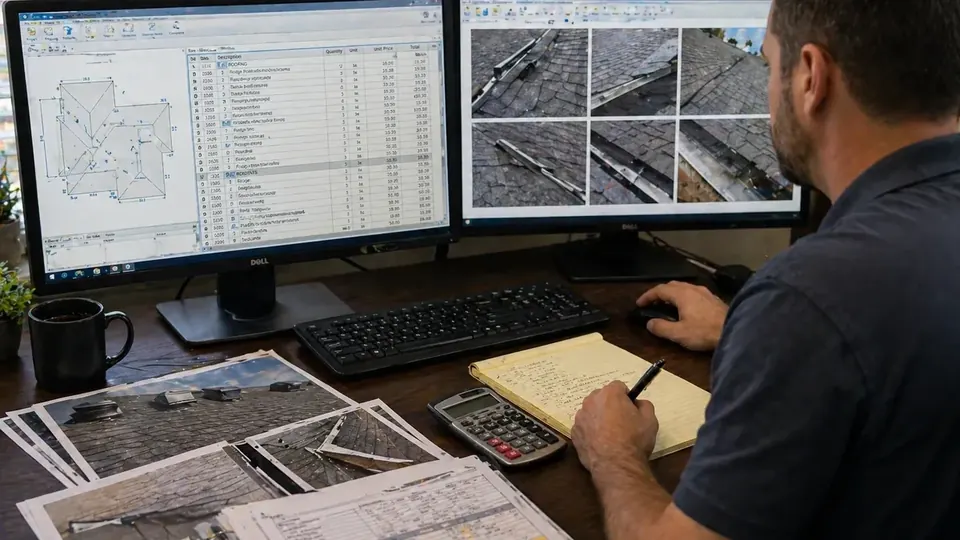
The estimate your insurer sends is the foundation of your claim payment, yet most property owners receive it with little explanation. Line items carry abbreviations, quantities are in squares and linear feet, and the summary page subtracts depreciation and deductibles in ways that are hard to follow. An insurance estimate review in San Marcos compares that document with the damage at your property, item by item. As a San Marcos public adjuster, we read estimates the way insurers write them, so we can show you where the scope, quantities, or pricing may fall short.
What We Look at in an Estimate Review
| Estimate section | Questions we ask |
|---|---|
| Summary page | Are RCV, depreciation, deductible, and prior payments correct? Is depreciation marked recoverable where the policy allows? |
| Areas and structures | Is every damaged room, roof slope, elevation, and outbuilding included? |
| Quantities | Do roof squares, waste factor, wall and ceiling area, and linear footage match measurements? |
| Line items | Are components such as starter, drip edge, flashing, vents, underlayment, trim, paint, and insulation present? |
| Repair vs. replace | Does a spot repair make sense, or are materials discontinued, brittle, or unmatchable? |
| Pricing | Is the price list region and date current? Do specialty items reflect local cost? |
| Code and permits | Are code-required items included, and does ordinance or law coverage apply? |
| General conditions | Are debris removal, dumpsters, protection, permits, and contractor overhead and profit addressed? |
Common Gaps in San Marcos Estimates
Every claim is different, but certain patterns come up often in Hays County properties:
- Composition shingle roofs in subdivisions along I-35: missing starter strip, ridge cap, drip edge, step flashing, or a waste factor that is too low for a cut-up roof.
- Metal roofs on Hill Country homes, barns, and workshops west of town: hail dents treated as cosmetic, or panel replacement priced without trim and fasteners. Some policies limit cosmetic damage on metal roofs, so the policy wording matters.
- Stone, brick, and stucco exteriors: masonry and stucco repairs priced as if they were siding, or matching issues ignored.
- Older homes near downtown: plaster walls, wood windows, and trim profiles that standard line items do not capture.
- Water losses: drying equipment, baseboards, cabinets, and flooring continuity across rooms left out.
- Fences and other structures: wood and metal fences, sheds, and carports often omitted after hail or wind.

Understanding the Numbers on the Summary Page
Many San Marcos homeowners call us because the check looks too small compared with the estimate total. Often the estimate math is working as designed: replacement cost minus depreciation gives actual cash value, then the deductible and any prior payments are subtracted. On many replacement cost policies, the withheld depreciation can be recovered once repairs are finished. Some Texas policies pay roofs only at actual cash value or on a payment schedule, which changes the picture. Our claim calculator lets you check the arithmetic, and our article on replacement cost vs. actual cash value explains depreciation in more detail.
A review separates two different problems: a correct estimate that simply pays in stages, and an estimate that leaves out real damage. The first may only need recoverable depreciation requested at the right time. The second needs documentation.
Reading the Line Items Yourself
You do not need to be an estimator to spot many problems. With your estimate in hand, walk the property and try this:
- Match every area. List each damaged room, roof slope, wall, and structure, then find it in the estimate. Anything missing is worth flagging.
- Check the descriptions. "Detach and reset" means an item is removed and put back, not replaced. "R&R" means remove and replace.
- Look at quantities. A bedroom with 12-foot walls priced as 8-foot walls, or a two-story elevation priced as one, will show up as a short quantity.
- Read the notes. Adjusters often explain decisions in line notes, such as why an item was repaired instead of replaced.
- Compare with bids. Ask contractors for itemized bids so you can compare like with like.
Our guide to reviewing a roof estimate walks through the roofing line items specifically.
How a San Marcos Public Adjuster Reviews Your Estimate
- Gather the file. We collect the insurer's full estimate, photo report, payment letters, and your policy and declarations page.
- Inspect the property. We document damage with photos and measurements, using Matterport 3D imaging where it helps capture rooms or structures.
- Compare line by line. We note missing items, quantity differences, repair-vs-replace issues, and pricing concerns.
- Prepare our own estimate. We build a detailed Xactimate estimate so differences are visible in the same format the insurer uses.
- Explain the results. We walk you through what we found and what the options are, whether that is a supplement, a request on an underpaid claim, or, if the dispute is only about amount, appraisal.
Sometimes the review shows the insurer's estimate is reasonable. That is useful to know too, and we will tell you plainly. An honest answer early can save you time, and it lets you focus on what matters next, such as finishing repairs and requesting recoverable depreciation before any policy deadline.
Timing matters as well. A review is most useful before repairs begin, while damage can still be photographed and measured. If repairs are already underway, keep removed materials when practical and photograph each stage, so anything found during the work can still be documented.
Local Codes Can Change the Scope
The City of San Marcos adopted the 2021 International Codes, in effect since April 1, 2023. A local amendment exempts roof covering replacement from permits unless the new roof is heavier than the existing one, and all foundations must be designed by a licensed engineer. Other repairs may require permits through the city Permit Center. Code-driven costs are payable only to the extent your policy includes ordinance or law coverage. Our local building codes page has more.
Get a Second Look at Your Estimate
We serve property owners in San Marcos, Hays County, and surrounding Central Texas communities, for both residential and commercial claims. Fees are disclosed in a written contract before any work begins; Texas law caps public adjuster compensation at 10% of the insurance settlement. We cannot guarantee an increase in your payment. To have a licensed San Marcos public adjuster review your estimate, request a Free Claim Review.
Frequently Asked Questions
What is Xactimate?
Xactimate is estimating software widely used by insurers, adjusters, and contractors. It organizes repairs into line items with quantities and unit prices from regional price lists that are updated over time. Because many insurers use it, an estimate prepared in the same software is easier to compare.
What should I check first on my estimate?
Start with the summary page: replacement cost, depreciation, deductible, prior payments, and net claim. Then compare the rooms and areas listed with every area that was damaged. Missing rooms, elevations, or structures are among the easiest gaps to spot.
What does overhead and profit (O&P) mean on an estimate?
O&P stands for general contractor overhead and profit. When a repair reasonably requires a general contractor to coordinate several trades, many estimates include O&P. Whether it applies to your claim depends on the scope and the insurer's position.
Why is the price list date important?
Xactimate price lists are tied to a region and a date. If an estimate uses an older price list, unit costs may not reflect current local labor and material costs, especially after a large storm increases demand.
Can I review the estimate myself?
Yes, and you should read it. Walk the property with the estimate in hand and check off each damaged item. A professional review helps most with quantities, code items, pricing, and the trade-specific line items that are easy to miss.
What happens after the review finds problems?
The differences can be documented and presented to the insurer as a supplement or reconsideration request. If the insurer and policyholder still disagree on the amount, appraisal may be an option under the policy. No outcome is guaranteed.