Key takeaways
- Commercial property claims usually involve several coverages at once: building, business personal property (BPP), business income, and extra expense, each with its own limits and conditions.
- A coinsurance clause can reduce payment on a partial loss if the property was underinsured. Agreed value options may suspend it.
- Low-slope membrane roofs and metal roofs, common on commercial buildings along I-35, raise specific damage and coverage questions after hail and wind.
- Leases, mortgagees, HOA governing documents, and tenant policies often decide who claims what. Deadlines in the policy and Texas law keep running throughout.
A storm that damages a home is stressful. A storm that damages a business adds payroll, tenants, customers, lenders, and lost revenue to the list. Commercial property insurance claims in San Marcos follow the same basic steps as residential claims, but the policies are more complex, more people have a stake in the outcome, and small details in the forms can make a large difference. This guide is for business owners, landlords, student-housing and multifamily owners, and homeowners associations in San Marcos and across Hays County.
We work as a San Marcos public adjuster representing policyholders on residential and commercial property claims. Coverage always depends on your policy and the facts of the loss, and nothing here is legal advice.
Who this applies to in San Marcos
San Marcos is the Hays County seat on Interstate 35 (I-35), home to Texas State University, and part of a fast-growing corridor between Austin and San Antonio. That mix produces a wide range of commercial property:
- Retail and service businesses along I-35 and in shopping centers, many under flat or low-slope roofs.
- Landlords and property managers with single-family rentals, duplexes, and small strip centers.
- Student-housing and multifamily owners near Texas State, where one storm can affect many units and many tenants.
- Homeowners associations and condominium associations responsible for common elements, clubhouses, fences, and in some cases roofs.
- Churches, offices, warehouses, and agricultural buildings, including metal buildings in the Hill Country west of town.
Storm history shows why these owners should understand their coverage. The NOAA Storm Events Database records 4.25-inch hail on April 20, 2006 along I-35 near the San Marcos outlet malls, and 70 to 80 mph winds on January 13, 2007 that tore metal roofs off several buildings along I-35 in San Marcos (NOAA NCEI event record). On May 9, 2024, 70 mph gusts damaged the roof of a church in San Marcos (NOAA NCEI event record).
Building vs. business personal property vs. business income
Most commercial property policies are built from several coverage parts. Knowing which one applies to each piece of damage is the first step in a well-organized claim.
| Coverage | What it generally covers | Common issues on claims |
|---|---|---|
| Building | The structure, permanently installed fixtures, machinery, and equipment; often outdoor fixtures as defined | Roof scope, code items, matching, ACV vs. replacement cost, coinsurance |
| Business personal property (BPP) | Furniture, inventory, equipment, and certain tenant improvements and betterments owned by the business | Inventory records, valuation, separating owner and tenant property |
| Business income | Lost net income and continuing normal operating expenses during the period of restoration after covered physical damage | Waiting periods, proving lost income, defining when restoration should end |
| Extra expense | Reasonable costs to avoid or reduce a shutdown, such as temporary space or expedited repairs | Documenting why each cost was necessary |
| Rental income / loss of rents | Rent lost when units are untenantable after covered damage | Lease records, vacancy before the loss, unit-by-unit timelines |
| Ordinance or law | Added costs to comply with building codes when repairing covered damage, up to a limit | Low or absent limits; showing what the code requires |
Business income claims deserve special attention. They usually require profit and loss statements, tax returns, sales records, and payroll data, along with a clear explanation of how the damage affected operations. Many forms include a waiting period before coverage applies. Start gathering financial records early, and keep a simple log of closures, reduced hours, and extra costs.
Coinsurance: how underinsurance can shrink a payment
Many commercial property policies include a coinsurance clause. In plain terms, it requires you to carry insurance equal to at least a set percentage, often 80%, 90%, or 100%, of the property’s value at the time of loss. If you carry less, the insurer may reduce the payment on a partial loss in proportion to the shortfall.
Suppose a building has a replacement cost value of $1,000,000 at the time of loss, and the policy has an 80% coinsurance clause. The required amount of insurance is $800,000. The owner carried only $600,000.
A hailstorm causes $100,000 of covered damage. Under a typical coinsurance formula, the insurer divides the amount carried by the amount required ($600,000 ÷ $800,000 = 75%) and applies that to the loss: $100,000 × 75% = $75,000, less the deductible. If the deductible were $5,000, the payment would be $70,000 instead of $95,000.
These numbers are invented to show the math. Your policy’s wording, valuation basis, and deductible terms control how coinsurance applies.
Values in the I-35 corridor have changed quickly, so limits set years ago may not keep up with current construction costs. Some policies offer an agreed value option that suspends coinsurance for a period, so it is worth reviewing your declarations with your agent before a loss. After a loss, a careful review of the insurer’s valuation can matter, because the coinsurance calculation depends on it.
Low-slope and metal roofs on commercial buildings
Roofs drive most commercial storm claims in Central Texas, and commercial roofs differ from residential shingle roofs in ways that affect a claim.
Low-slope membrane roofs
Flat and low-slope roofs are common on retail, office, and multifamily buildings along I-35. Membranes such as TPO, modified bitumen, and built-up roofs can be damaged by hail in ways that are hard to see, such as fractures in the membrane, crushed insulation underneath, or damage at seams and flashings. Testing and core samples are sometimes used to evaluate the roof system. Rooftop HVAC units, curbs, skylights, and drains should be inspected as part of the same claim.
Metal roofs
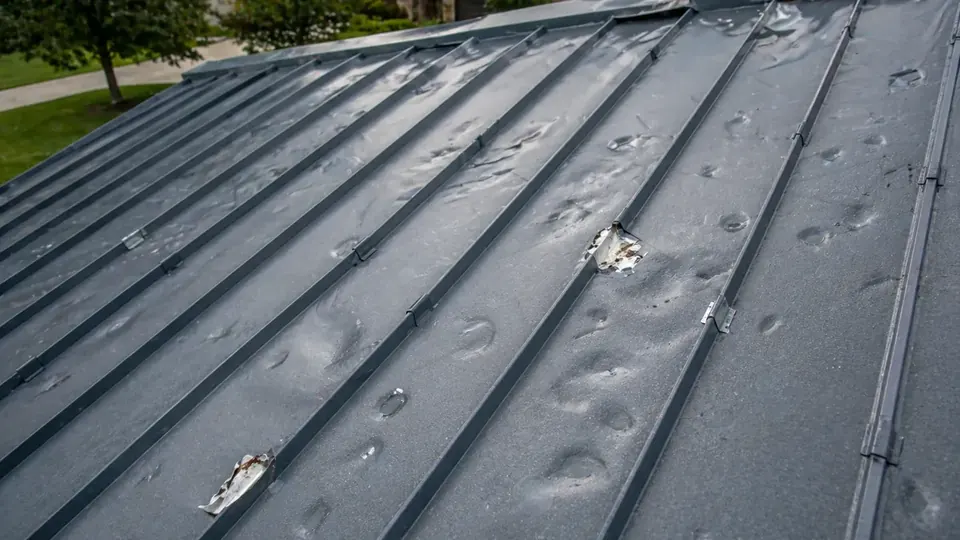
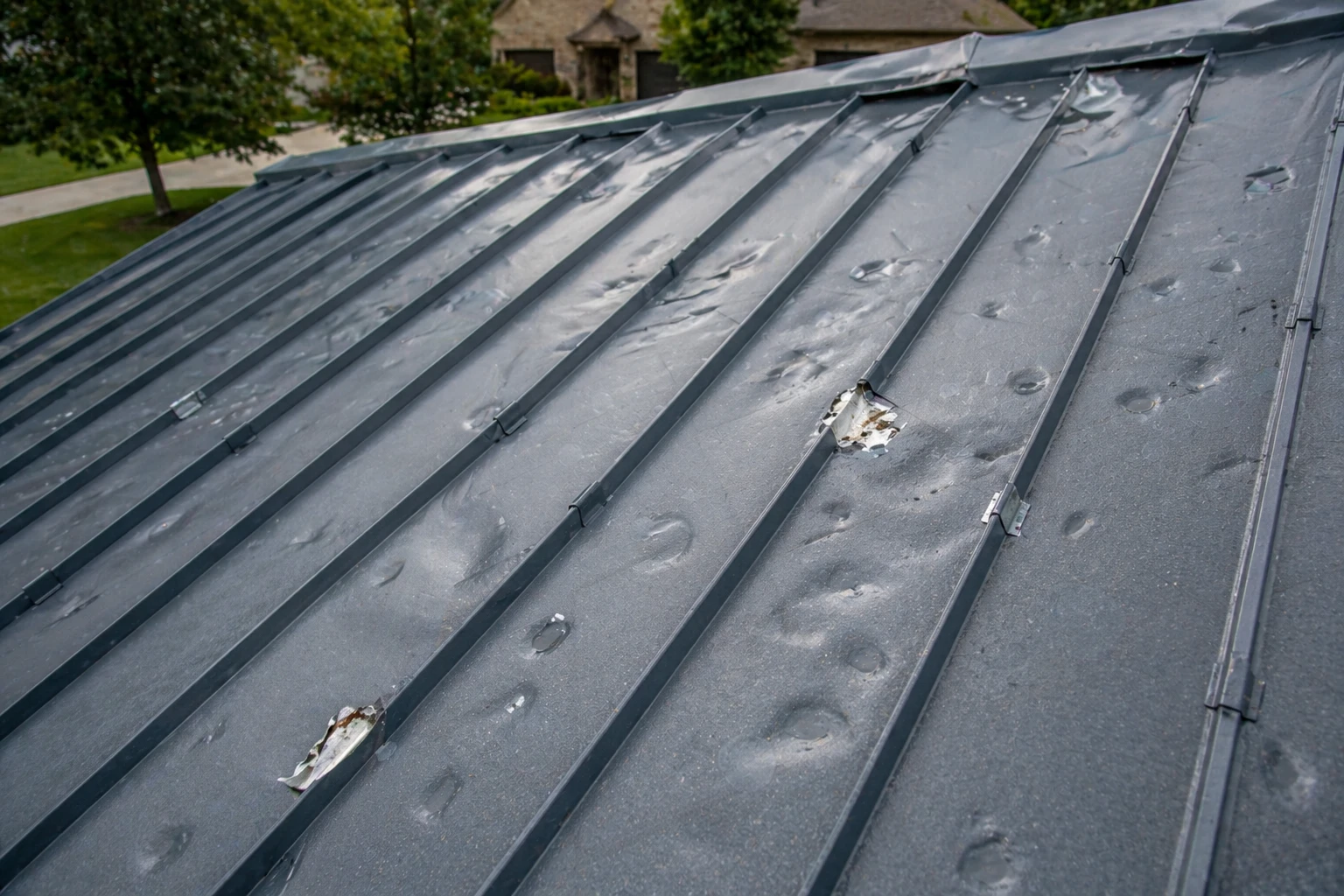
Standing-seam and exposed-fastener metal roofs are common on warehouses, churches, barns, and Hill Country buildings. Hail can dent panels, and wind can lift or peel them, as several NOAA reports in Hays County describe. Many commercial policies include endorsements that exclude cosmetic damage to metal roofing, meaning dents that do not affect function. Whether a particular dent is cosmetic or functional, such as one that affects seams, fasteners, coatings, or water-shedding, is often the core question on these claims.
Codes and permits
The City of San Marcos applies the 2021 International Codes, including the IBC, IECC, and IEBC, in effect since April 1, 2023. Reroofing a commercial building can bring up code items such as insulation or roof drainage requirements. Whether the insurer pays for those upgrades depends on ordinance or law coverage. In unincorporated Hays County, the county applies the 2018 International Fire Code to new commercial and multifamily buildings and major remodels. See our local building codes page for details and links.
Documentation for a commercial claim
Commercial insurers typically ask for more documentation than on a homeowners claim. Being ready can help keep the claim moving. Useful items include:
- The complete policy, including declarations, all coverage forms, and endorsements.
- Dated photos and video of all damage, inside and out, before cleanup where safe.
- Building plans, roof reports, and maintenance and repair records.
- Inventory and equipment lists with purchase records.
- Financial records for business income: profit and loss statements, tax returns, and sales and payroll reports.
- Leases, rent rolls, and tenant notices for rental and multifamily properties.
- Invoices for emergency repairs and mitigation, such as tarping, water extraction, and board-up.
Our claim documentation checklist is a good starting point, and our storm lookup tool can help you find weather records for your date of loss.
Tenant, lender, and association issues
Commercial claims often involve more than one insured party, and the paperwork that connects them matters.
- Leases. Commercial leases typically say who must insure the building, who insures improvements, who repairs what, and whether rent abates after damage. Read the insurance and casualty sections early.
- Tenant improvements. Improvements a tenant paid for may be covered under the tenant’s BPP coverage, not the landlord’s building coverage. Coordinate so items are not missed or claimed twice.
- Student and multifamily tenants. Tenants’ belongings are usually covered by their own renters policies, if they have one. The owner’s policy may cover loss of rents while units are being repaired.
- HOAs and condos. The association’s master policy and governing documents define which parts are common elements. Unit owners often have separate policies for their interiors and personal property.
- Mortgagees. Lenders are often named on claim checks and may control the release of funds. Ask for their requirements in writing.
Deadlines that apply to commercial claims
Deadlines do not pause because a claim is complicated. Keep these in view:
- Notice. Most policies require prompt notice of a loss. Report it as soon as you reasonably can.
- Proof of loss. Some policies require a sworn proof of loss within a set time after the insurer asks for it.
- Prompt Payment rules. Texas Insurance Code Chapter 542, Subchapter B sets timelines for insurers to acknowledge, decide, and pay. Eligible surplus lines insurers, common in commercial property, have different timeframes. See why property insurance claims are delayed in Texas.
- Replacement cost. Many policies pay actual cash value first and the rest after repairs are completed within a set period.
- Suit limitations. Many Texas property policies limit the time to file suit, often two years and one day from when the claim accrued. Talk to a Texas attorney about any legal deadline.
Flood is a separate matter. Commercial property policies generally exclude flood, and flood coverage comes from the NFIP or private flood insurers (FloodSmart). New FEMA flood maps for the Blanco River, the San Marcos River, and several creeks took effect in San Marcos on January 17, 2025, so it is worth checking your building’s current zone.
Getting help with a San Marcos commercial claim
A business owner’s time is usually best spent running the business, not managing an insurance file. That is the main reason commercial clients contact a public adjuster in San Marcos. A public adjuster can document the loss, prepare a detailed estimate, organize business income records, and handle communication with the insurer on behalf of the named insured. If you are weighing outside help for a commercial property claim, a San Marcos public adjuster can review your policy and the insurer’s position at no cost. Request a Free Claim Review or call +1 (832) 503-5866. Fees are disclosed in a written contract before any work begins; Texas law caps public adjuster compensation at 10% of the insurance settlement.
Frequently Asked Questions
What is the difference between building coverage and business personal property coverage?
Building coverage generally applies to the structure and permanently installed fixtures and equipment. Business personal property (BPP) generally covers furniture, inventory, equipment, and certain tenant improvements that belong to the business. The exact definitions are in your policy forms, and leases often affect who insures what.
How does coinsurance affect a commercial claim?
If your policy has a coinsurance clause and you carried less insurance than the required percentage of the property’s value at the time of loss, the insurer may reduce the payment proportionally, even on a partial loss. Some policies use agreed value or other options that suspend coinsurance. Check your declarations and policy forms.
Does business income coverage start right away?
Often not. Many business income forms have a waiting period before lost income is covered, and coverage usually applies to the period of restoration after direct physical loss from a covered cause. Extra expense coverage may pay certain costs to keep operating. Read your forms for the specific terms.
Who files the claim when a tenant’s space is damaged?
It depends on the lease and the policies. The landlord’s policy often covers the building, while the tenant’s policy often covers its own property and improvements it paid for. Both may have claims from the same event. Review the lease insurance and repair provisions early.
Are commercial flood losses covered by a commercial property policy?
Commercial property policies generally exclude flood. Flood coverage for commercial buildings and contents is usually purchased separately through the National Flood Insurance Program or a private flood insurer.
Can a public adjuster help with an HOA or multifamily claim?
Yes. A public adjuster can represent the named insured on the master or building policy, including associations and multifamily owners. Individual unit owners or tenants usually have separate policies and separate claims.
Sources and further reading
This article is general information about property insurance claims in Texas, not legal advice, and not a promise of any coverage or outcome. Your policy language and the facts of your loss control your claim.