Key takeaways
- The City of San Marcos enforces the 2021 International Codes and the 2020 NEC, in effect since April 1, 2023.
- A local amendment says a roof covering replacement permit is not required unless the new roof is heavier than the existing covering.
- Nearby cities run their own permit offices, and Hays County does not issue residential building permits in unincorporated areas.
- Code requirements do not automatically mean your insurer pays for upgrades. Ordinance or law coverage, and its limit, usually decides that.
- Code items get paid more often when they are documented clearly: the code section, the photo, the measurement and the cost.
When a hailstorm or windstorm damages a home in San Marcos, the repair has to meet the building codes in force today, not the codes that were in place when the house was built. That gap between "put it back the way it was" and "build it the way the code now requires" is one of the most common sources of disagreement on property claims. This guide explains how San Marcos building codes and insurance repairs fit together: which codes the city enforces, when a reroof needs a permit, what ordinance or law coverage does, and how to document code items so they are not quietly left off an estimate.
It is written for homeowners and business owners in San Marcos, Hays County and nearby Central Texas communities. It is general information, not legal advice, and every claim depends on the policy language and the facts of the loss.
Which building codes San Marcos enforces
The City of San Marcos adopted the 2021 editions of the International Codes, along with the 2020 National Electrical Code, through Ordinance 2023-09. According to the city’s Codes & Ordinances page, these codes have been in effect since April 1, 2023. As of this writing, the city website still lists the 2021 editions as current.
| Code (2021 edition unless noted) | What it governs | Why it can matter on a claim |
|---|---|---|
| International Residential Code (IRC) | One- and two-family homes and townhouses | Roof coverings, underlayment, flashing, framing and many items in a typical home repair |
| International Building Code (IBC) | Commercial, multifamily and other non-IRC buildings | Commercial roofs, structural repairs and life-safety items |
| International Energy Conservation Code (IECC) | Energy efficiency | Insulation, windows and some roof or wall assemblies when replaced |
| International Existing Building Code (IEBC) | Repairs and alterations to existing buildings | Sets how much of a damaged building must be brought up to current code |
| IMC, IPC, IFGC | Mechanical, plumbing and fuel gas | HVAC, water heaters, piping and venting after fire, freeze or water losses |
| International Fire Code (IFC) | Fire safety | Commercial and multifamily repairs, alarms and access |
| International Property Maintenance Code (IPMC) | Minimum standards for existing properties | Habitability issues and unsafe conditions after a loss |
| National Electrical Code (2020) | Electrical wiring and equipment | Rewiring after fire or water damage, panel and circuit protection |
The city also adopted a swimming pool and spa code and several local amendments. Two of those amendments come up often on claims: the reroof permit rule described below, and a requirement that all foundations be designed by a licensed engineer.
The San Marcos reroof permit rule
Many Texas cities require a permit for every roof replacement. San Marcos took a different approach. In its amendments to both the IRC and the IBC, the city says that roof covering replacement permits are not required unless the weight of the replacement roof is heavier than the existing roof covering.
In practice, that means a like-for-like composition shingle replacement on a house in a San Marcos subdivision often will not need a permit. Moving to a heavier covering, such as from shingles to concrete or clay tile, may. If you are not sure, the city publishes a Permit Requirement Determination Form that lists re-roofing as an example of work it can rule on, or you can contact the Permit Center directly.
630 E. Hopkins Street, San Marcos, TX 78666 · 512-805-2630 · permitinfo@sanmarcostx.gov. Online permit applications go through MGO Connect (mgoconnect.org). See the city’s Permit Center page for current details.
No permit does not mean no code
This is the point that trips people up. The model codes generally say that an exemption from a permit does not authorize work that violates the code. A reroof that needs no permit is still expected to be installed the way the adopted IRC or IBC and the manufacturer’s instructions require. When a contractor bids the job properly, those requirements show up as line items. When an insurance estimate leaves them out, the gap shows up as an underpayment.
Permits outside the San Marcos city limits
The San Marcos rules apply inside the city. Properties nearby may be under a completely different authority:
- Other cities. Kyle, Buda, Wimberley, Dripping Springs, New Braunfels, Lockhart and Seguin each have their own permit offices. They may have adopted different code editions or their own amendments, including different reroof permit rules. Check with the city that covers your address before assuming the San Marcos rule applies.
- The San Marcos ETJ. The city’s ordinance requires a building permit for projects in the extraterritorial jurisdiction that receive City water, wastewater or electric service.
- Unincorporated Hays County. Hays County does not issue residential building permits or enforce a residential building code in unincorporated areas. It does handle septic (OSSF), development and floodplain permits, and it applies the 2018 International Fire Code to commercial and multifamily construction. See Hays County Development Permits.
Our local building codes page collects these resources in one place, and the service areas pages note the permit office for each community we serve.
Ordinance or law coverage: who pays for code upgrades
Here is the key insurance point: a code requirement does not automatically mean the insurer pays for it. A standard property policy pays to repair or replace covered damage. Many policies exclude, or limit, the extra cost of complying with an ordinance or law. That extra cost is usually covered by ordinance or law coverage, which pays, up to its limit, for increased costs to comply with building codes when repairing covered damage.
Ordinance or law coverage is often a separate, limited coverage or endorsement. On many residential policies it is expressed as a percentage of the dwelling limit. Some commercial policies split it into parts, such as the value of undamaged portions that must be torn down, the cost to demolish them, and the increased cost of construction. Some policies do not include it at all.
| Situation | Where payment often comes from | What to check |
|---|---|---|
| Item is a normal part of a like-kind repair (for example, standard underlayment under new shingles) | Often the main dwelling coverage | Whether the estimate includes it at all |
| Code requires something the old roof or system never had | Usually ordinance or law coverage, if the policy has it | The endorsement, its limit, and whether repairs must be completed first |
| Undamaged parts must be removed or upgraded to meet code | Ordinance or law coverage, depending on wording | Whether the policy covers undamaged portions and demolition |
| Code item unrelated to the covered damage | Often not covered | Whether the requirement is triggered by the repair of covered damage |
Many policies pay ordinance or law benefits only after the work is actually done, and some apply them on a replacement cost basis only when repairs are completed. Read the endorsement, and see our guide to replacement cost vs. actual cash value in Texas for how holdbacks work.
Common code-driven line items on insurance repairs
Code items vary by building type, roof covering, the code edition your city adopted, and the manufacturer’s installation instructions. Below are items that frequently come up on San Marcos-area claims. Whether any of them apply to your property is a question for your contractor and the local building official.
Roofing
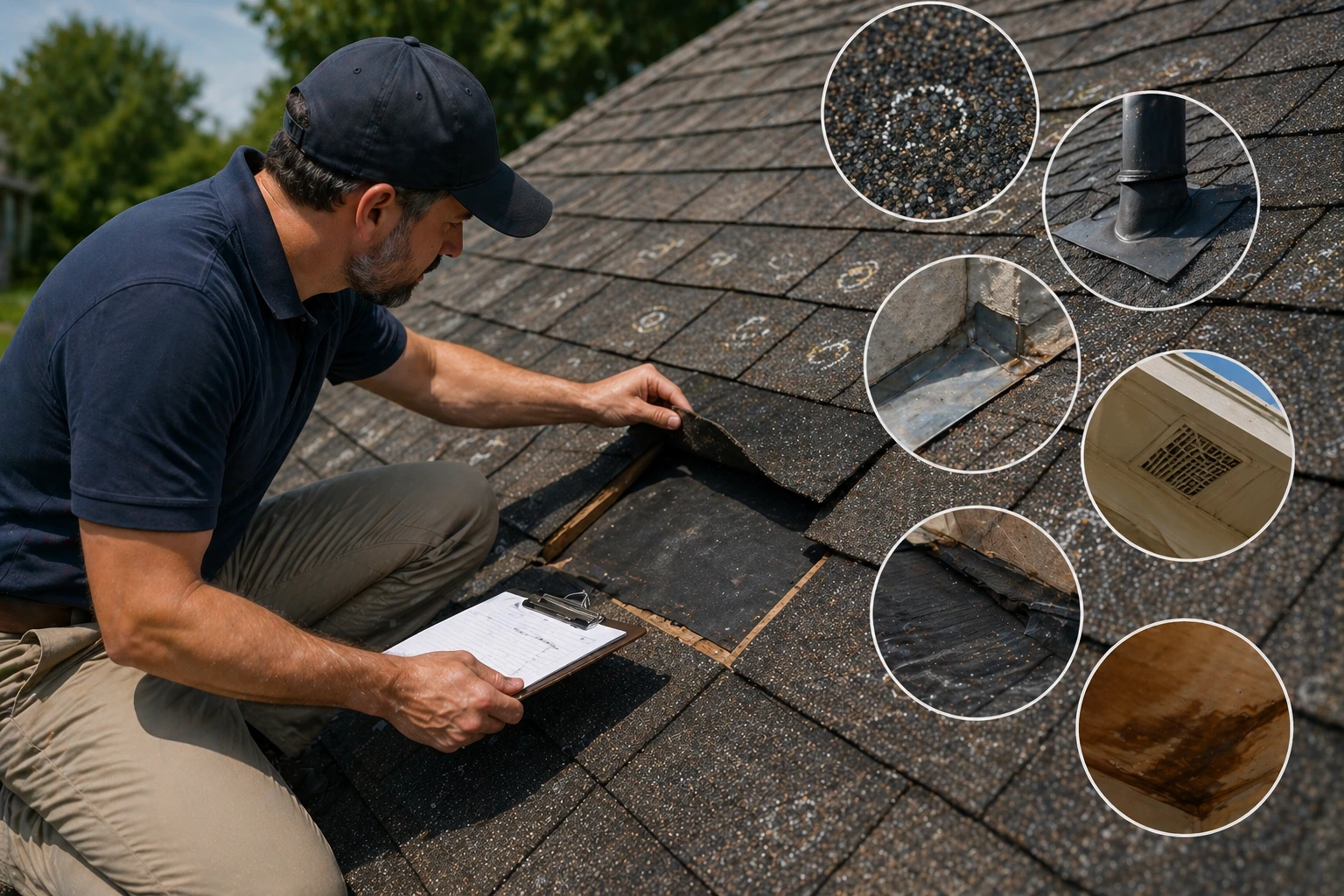
- Drip edge. The IRC requires drip edge at the eaves and rake edges of asphalt shingle roofs. Some older roofs were built without it, so it may be missing from both the old roof and the insurer’s estimate.
- Underlayment. The adopted IRC requires underlayment under roof coverings, installed to code and manufacturer specifications. Watch for estimates that price only a thin felt where the system or manufacturer calls for something different.
- Tear-off versus overlay. The IRC generally does not allow a new roof covering to be installed over two or more existing layers. If the house already has two layers, a full tear-off may be required.
- Flashing. Step flashing, counterflashing and valley flashing must be installed to code and manufacturer requirements. Reusing old, damaged flashing may not meet them.
- Roof ventilation. Replacing vents or changing the roof can bring attic ventilation requirements into play.
- Decking. Damaged, deteriorated or improperly spaced decking may need replacement before a new covering can go on.
You may notice that ice barrier is not on this list. The IRC ties ice barrier requirements to areas with a history of ice forming at the eaves, which is not typical in San Marcos. If an estimate or bid includes it, ask why.
Other trades
- Electrical. Rewiring after a fire or water loss can trigger current NEC requirements, such as circuit protection.
- Insulation and windows. Replaced assemblies may need to meet the IECC.
- Mechanical and plumbing. Replacing a water heater or HVAC equipment after a freeze or fire can bring updated venting, clearance or connection requirements.
- Foundations. In San Marcos, all foundations must be designed by a licensed engineer under the local amendment. That can matter on major fire or flood rebuilds.
- Commercial properties. Fire code, accessibility and structural requirements can be significant. Our commercial property claims page covers those losses.
How to document code items on your claim
Insurers tend to pay for code items when they can see exactly what is required, why it applies, and what it costs. A vague note that says "code upgrades needed" rarely gets far. Here is a practical approach:
- Get the policy and endorsements. Find out whether you have ordinance or law coverage, the limit, and any conditions such as completing repairs first.
- Identify the authority. Confirm which city or county has jurisdiction and which code edition it enforces. For San Marcos, cite the 2021 codes and the city’s Codes & Ordinances page.
- Name the requirement. Note the code section or the manufacturer instruction behind each item. Your contractor or the building official can help you identify it.
- Photograph existing conditions. Show what is there now: missing drip edge, two existing layers, deteriorated decking, undersized vents. Photos taken during tear-off are especially useful.
- Measure and price it. Each item should appear as its own line with a quantity and unit price, not buried in a lump sum.
- Keep the paperwork. If a permit is required, keep the permit, inspection results and any written correction notices from the building official.
- Submit in writing. Send code items to the adjuster as a written supplement request with the supporting documents attached.
Our claim documentation checklist can help you keep the evidence organized. If code items were left out after the work started, a claim supplement is the usual way to add them.
When a San Marcos public adjuster can help
Code items are a frequent reason estimates come in low, partly because they require reading the policy, the code and the estimate side by side. A San Marcos public adjuster can review your policy for ordinance or law coverage, compare the insurer’s estimate with what the adopted codes and manufacturer instructions call for, and prepare documentation for the missing items. Public adjusters represent the policyholder only and are licensed by the Texas Department of Insurance.
We cannot promise any particular result, and if your dispute turns on a legal question, such as how a policy exclusion should be interpreted, a Texas attorney is the right resource. For an underpaid claim where code items seem to be missing, or for a roof damage claim you are just starting, our Free Claim Review is a no-obligation way to get a second look. You can also read our guide on how to review an underpaid roof estimate.
As a San Marcos public adjuster serving San Marcos, Hays County, and surrounding Central Texas communities, we know a common pattern on property claims: the damage is covered, but the estimate prices a repair that could not be built that way under current code. Getting the code items documented early is one of the simplest ways to close that gap. Fees are disclosed in a written contract before any work begins; Texas law caps public adjuster compensation at 10% of the insurance settlement.
Frequently Asked Questions
Do I need a permit to replace my roof in San Marcos?
Under the City of San Marcos’s local amendment to the 2021 codes, a roof covering replacement permit is not required unless the replacement roof is heavier than the existing roof covering. If you are unsure whether your project needs a permit, the city offers a Permit Requirement Determination Form, or you can call the Permit Center at 512-805-2630. Properties in other cities need to check with that city’s permit office.
Does my insurance company have to pay for building code upgrades?
Not automatically. Costs to bring undamaged or outdated components up to current code are usually paid under ordinance or law coverage, which is often a separate, limited coverage or endorsement. Some code-required items that are simply part of a normal, like-kind repair may be included in the base estimate. It depends on your policy wording and the facts of the loss, so check your declarations page and endorsements.
Which building codes apply in San Marcos?
According to the city, the 2021 International Codes (including the IRC, IBC, IECC and IEBC) and the 2020 National Electrical Code have been in effect since April 1, 2023, adopted with local amendments by Ordinance 2023-09.
What if my home is outside the San Marcos city limits?
Kyle, Buda, Wimberley, Dripping Springs, New Braunfels, Lockhart, Seguin and other cities run their own permit offices and may adopt different code editions or amendments. Hays County does not issue residential building permits in unincorporated areas, though it does regulate septic, development and floodplain matters. Check with the authority that covers your address.
If no permit is required, do code requirements still matter on my claim?
They can. Under the model codes, an exemption from a permit generally does not authorize work that violates the code. Whether a code item is owed on your claim is a separate question that depends on your policy and how the item relates to the covered damage.
Can a public adjuster help with code upgrade items?
A public adjuster can review your policy for ordinance or law coverage, identify code-related line items, and document why they apply to the repair. A public adjuster cannot give legal advice; coverage disputes that turn on legal questions should go to a Texas attorney.
Sources and further reading
This article is general information about property insurance claims in Texas, not legal advice, and not a promise of any coverage or outcome. Your policy language and the facts of your loss control your claim.