Key takeaways
- Most roof estimates are written in Xactimate, line by line. Each line is a quantity times a unit price, so small errors add up.
- Check the measurements first: roof area in squares, waste factor, and linear feet of eaves, rakes, ridges, hips and valleys.
- Commonly missed items include starter, drip edge, ridge cap, flashing, vents, steep and high-roof charges, and code-required items.
- Overhead and profit and matching depend on the scope of the repair and your policy.
- Request a supplement in writing, item by item, with photos and measurements attached.
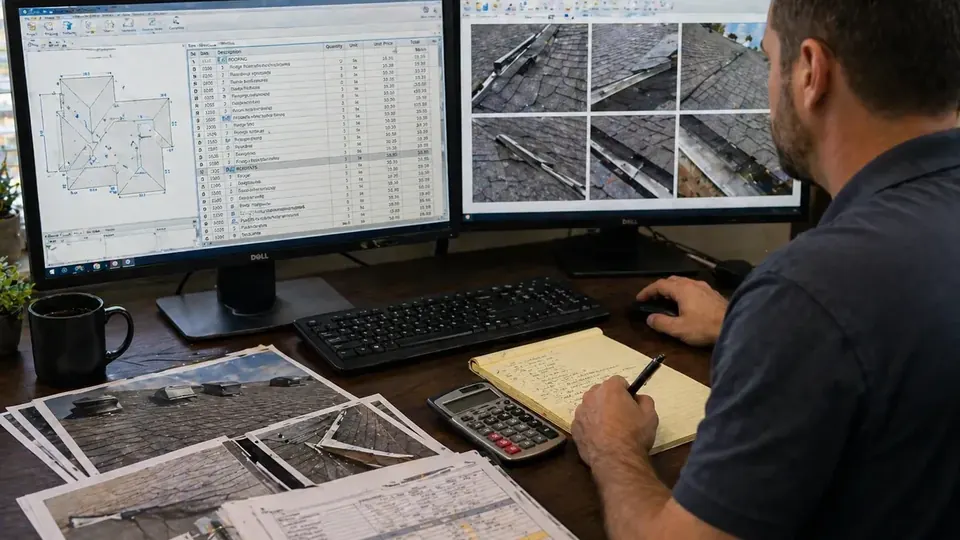
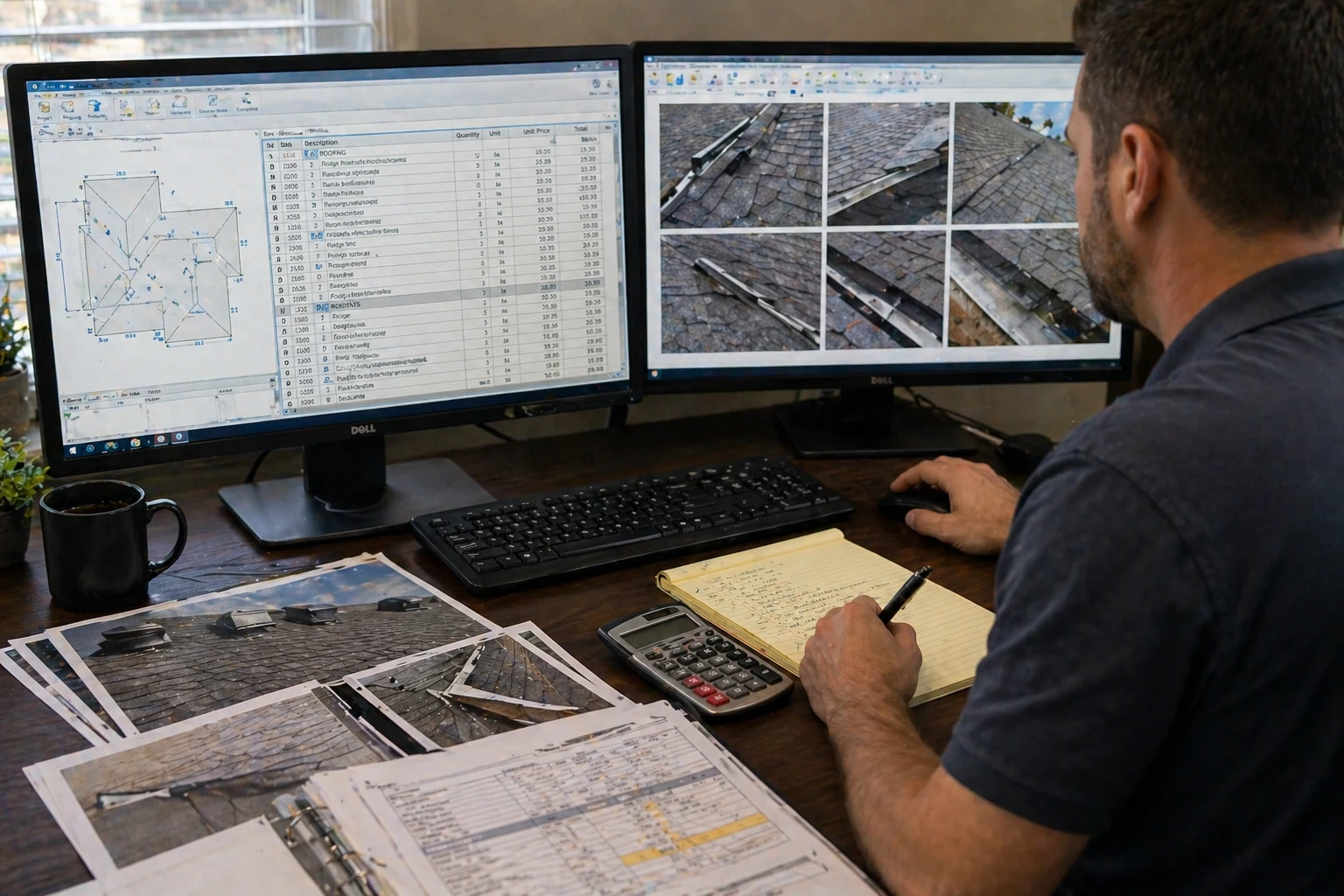
If the insurance check for your roof will not cover a contractor’s bid, the problem is often hiding in the estimate itself. Learning how to review an underpaid roof insurance estimate line by line can help you find what was missed, mismeasured or priced too low, and ask for it in a way an adjuster can act on. This guide walks through a typical Xactimate roof estimate section by section, with a checklist table you can use on your own claim.
It is written for homeowners and property owners in San Marcos, Hays County and nearby Central Texas communities, where hail and wind claims are common. It is general information, not legal advice.
Start with the estimate summary and your policy
Before you look at individual lines, read the summary page. It usually shows the replacement cost (RCV), depreciation, actual cash value (ACV), deductible and net payment. If the gap between your contractor’s bid and the insurer’s number is mostly depreciation and deductible, the issue may be how the policy pays, not the estimate itself. Our guide to replacement cost vs. actual cash value in Texas explains that difference.
Then check your declarations page for how the roof is covered (replacement cost, ACV or a roof payment schedule), your wind/hail deductible, and whether you have ordinance or law coverage. Those three facts frame everything else.
Line-by-line review of a roof insurance estimate
1. Roof measurements and squares
A roofing square is 100 square feet. The estimate should show the total roof area, usually from a sketch or an aerial measurement report, and the number of squares for tear-off and for new shingles. Compare it with an independent measurement. Look for slopes left out of the sketch, porch or garage roofs that were skipped, and pitch values that are lower than the real roof. Pitch affects area, so an understated pitch understates the squares.
2. Waste factor
Removal is measured at the actual roof area, but new shingles have to include waste for cutting at hips, valleys, rakes and penetrations. A simple gable roof needs less waste than a cut-up roof with many hips and valleys. If the estimate applies a low waste percentage to a complex roof, or no waste at all, that can be a meaningful shortfall. Ask what waste factor was used and how it was chosen.
3. Starter course
Many shingle manufacturers call for a starter strip along the eaves, and some also call for it along the rakes. Check that starter appears as its own line with linear feet that match the eaves (and rakes, if the manufacturer requires it). Estimates sometimes assume starter is covered by waste, which may not be consistent with how the roof is actually installed.
4. Ridge and hip cap
The estimate should include ridge or hip cap shingles for the full linear feet of ridges and hips. Laminated (architectural) shingle roofs typically use manufactured hip and ridge cap, which is priced differently from cut three-tab pieces. Compare the linear feet with your measurement report.
5. Drip edge
The IRC requires drip edge at the eaves and rake edges of asphalt shingle roofs. Check that drip edge is included for the full eave and rake length. If the old roof had none, replacing the roof may still require it, which ties into code items below.
6. Underlayment
The adopted IRC requires underlayment under roof coverings. Confirm the estimate includes underlayment for the full area and that the type matches what the installation requires.
7. Flashing
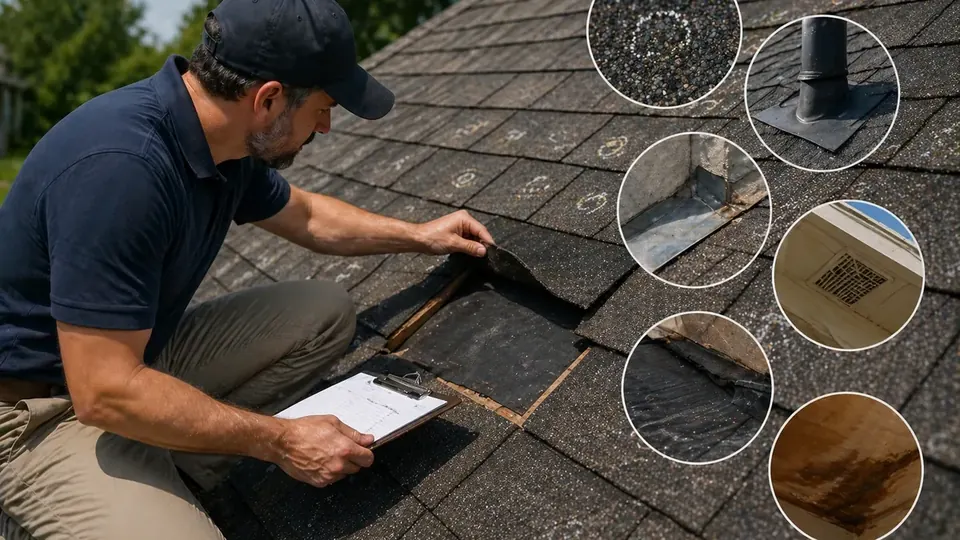
Look for step flashing along walls, counterflashing, chimney flashing, valley metal if used, and headwall or apron flashing. Flashing is often damaged or bent during tear-off, and reusing old flashing may not meet code or manufacturer instructions. If the estimate does not mention flashing, ask why.
8. Vents and penetrations
Count every roof penetration: pipe jacks (plumbing vent boots), box or turtle vents, ridge vent, turbine vents, power vents, exhaust caps and furnace or water heater flues. Hail commonly dents soft metal vents, and each one should have a line. Detach-and-reset items such as satellite dishes or solar equipment should also appear if they must be moved.
9. Steep and high-roof charges
Working on a steep roof or a tall roof takes longer and requires more safety equipment. Xactimate has separate additional charges for steep roofs (by pitch range, typically starting at 7/12) and for high roofs (generally two stories or more). If your roof is steep or two stories and these charges are missing, that can be a significant gap. Check that they are applied to the right slopes and quantities, for both removal and installation.
10. Tear-off, layers, decking and disposal
If there are two existing layers, the estimate should price removal of both. Check for debris removal or dumpster charges, and for decking replacement where the decking is damaged or deteriorated. Decking problems are often discovered only during tear-off, which is a common reason for a supplement.
11. Overhead and profit (O&P)
Overhead and profit covers a general contractor’s costs and margin for coordinating the job. It is often written as 10% overhead plus 10% profit. Insurers generally include it when the repair reasonably requires a general contractor, for example when several trades are involved (roofing, gutters, siding, painting, interior repairs). It is not owed automatically on every claim, but if your repair involves multiple trades and O&P is missing, ask the adjuster to explain the decision in writing.
12. Code-required items
The City of San Marcos enforces the 2021 International Codes, in effect since April 1, 2023. A local amendment means a roof covering replacement usually does not need a permit unless the new roof is heavier than the old one, but the work is still expected to meet code. Items the adopted IRC and the manufacturer require should be in the estimate. Whether upgrades beyond a like-kind repair are paid usually depends on ordinance or law coverage. Our article on building codes and insurance repairs in San Marcos covers this in detail, and our local building codes page lists permit offices for nearby cities.
13. Matching
If the insurer approves only some slopes, ask whether the replacement shingles will reasonably match the rest of the roof in color, style and size. Discontinued shingles are a common issue. Whether the insurer must pay to replace undamaged areas to achieve a match depends on your policy language and the facts. Document the shingle brand and line, any evidence it is discontinued, and photos showing the visible difference.
14. Unit prices, labor minimums and the price list
Estimates use a price list for a specific region and month. Confirm the price list matches your area and the time of the loss or repair. Watch for items priced as a repair when a replacement is needed, and for labor minimums omitted on small trades.
Roof estimate review checklist
| Item | What to check | Evidence to gather |
|---|---|---|
| Squares | Total area matches the roof, every slope included, correct pitch | Measurement report, roof diagram |
| Waste factor | Reasonable for the roof’s complexity | Measurement report showing hips, valleys and suggested waste |
| Starter | Eave (and rake if required) linear feet | Manufacturer installation instructions |
| Ridge / hip cap | Full linear feet; correct cap type for laminated shingles | Measurement report, photos |
| Drip edge | Full eave and rake length | Photos of edges, code reference |
| Underlayment | Full area, correct type | Manufacturer instructions, code reference |
| Flashing | Step, counter, chimney, valley, headwall | Close-up photos of each location |
| Vents and penetrations | Every vent, pipe jack, flue and cap counted | Photo of each penetration, hail dents on soft metals |
| Steep / high charges | Applied where pitch or height qualifies, for removal and install | Pitch measurements, photos showing stories |
| Tear-off and decking | All layers removed, decking replacement where needed, disposal | Photos of layers, tear-off photos of decking |
| O&P | Included if a general contractor is reasonably needed | List of trades involved |
| Code items | Items the adopted code requires | Code section, building official guidance, permit if any |
| Matching | Replacement shingles reasonably match | Shingle brand and line, discontinuation evidence, photos |
| Other exterior items | Gutters, downspouts, screens, siding, fences | Photos of hail or wind damage on each |
Our claim documentation checklist can help you collect the photos and records listed above.
Check the damage scope, not just the line items
Sometimes the estimate is accurate for what it covers, but it covers too little: a few slopes or a "spot repair" when hail damage is spread across the roof. Compare the approved scope with photos from every slope. Hail damage in Hays County can be significant. NOAA records 58 hail reports of golf-ball size or larger in the county since 1967, and on May 9, 2024 it logged 2.5-inch hail near the outlet mall in San Marcos. Dated storm records from our storm lookup can help connect the damage to a specific event. For more on hail, see our hail damage claims page.
How to request a roof supplement

- List each item separately. Name the missing or underpaid line, the quantity and the unit (squares, linear feet, each).
- Explain why it is needed. Cite the manufacturer instruction, code requirement or condition found on the roof.
- Attach evidence. Photos, measurement reports, invoices and any building official correspondence.
- Send it in writing to the adjuster assigned to your claim, and keep a copy.
- Ask for a revised estimate or a written explanation for any item they decline.
- Follow up on time. Texas prompt-payment rules set timeframes for insurers to respond once they have the information they requested. Keep track of dates.
If additional damage or code items appear during tear-off, document them with photos before the new roof covers them up, and submit them promptly. Our article on hail damage claim supplements and our insurance claim supplements page go deeper. If the disagreement is over the amount of loss and cannot be resolved, appraisal may be available under your policy; see insurance appraisal.
Getting a second set of eyes from a San Marcos public adjuster
Reviewing an estimate takes time and familiarity with how insurance estimates are built. A San Marcos public adjuster can compare the insurer’s estimate with the roof, prepare a detailed estimate in the same format, and present the differences with the evidence behind them. Public adjusters are licensed by the Texas Department of Insurance and represent the policyholder only. We cannot promise a higher payment, and legal questions about coverage belong with a Texas attorney.
If your roof estimate looks short, our insurance estimate review and roof damage insurance claims pages explain how we work. A San Marcos public adjuster can review your estimate at no cost through our Free Claim Review. Fees are disclosed in a written contract before any work begins; Texas law caps public adjuster compensation at 10% of the insurance settlement.
Frequently Asked Questions
How do I know if my roof insurance estimate is too low?
Compare it line by line with the roof and with a detailed contractor bid. Common signs include a square count lower than the actual roof area plus waste, missing starter, ridge, drip edge or flashing, no steep or high-roof charges on a steep or two-story roof, and repairs priced on only some slopes when damage is spread across the roof.
What is a square in a roof estimate?
A roofing square is 100 square feet of roof surface. A roof measured at 2,800 square feet is 28 squares. Shingle quantities are usually higher than the measured area because they include a waste factor for cutting around hips, valleys and edges.
Is overhead and profit owed on every roof claim?
Not automatically. Overhead and profit is generally included when the repair reasonably requires a general contractor to coordinate the work, often because several trades are involved. Whether it is owed on your claim depends on the scope of the repair, your policy and the facts.
How do I request a supplement on a roof claim?
Send the adjuster a written request that lists each missing or underpaid line item with the quantity, the reason it is needed, and supporting evidence such as photos, measurements, manufacturer instructions or code references. Ask for a written response and a revised estimate.
Does my insurer have to pay to match undamaged shingles?
It depends on your policy language and the facts, such as whether replacement shingles that reasonably match are available. Document the shingle type and any discontinuation, and ask the insurer to explain its position in writing. Coverage questions about matching may need an attorney’s review.
Can a public adjuster review my roof estimate?
Yes. A licensed public adjuster can compare the insurer’s estimate with the roof, prepare a detailed estimate of their own, and present missing items to the insurer. A public adjuster cannot guarantee a higher payment.
Sources and further reading
This article is general information about property insurance claims in Texas, not legal advice, and not a promise of any coverage or outcome. Your policy language and the facts of your loss control your claim.