
Key takeaways
- The insurance adjuster, staff or independent, works for and is paid by the insurance company. A public adjuster is hired by and works for the policyholder.
- You pay nothing to the insurer’s adjuster. A public adjuster’s fee is set in a written contract, and Texas caps it at 10% of the insurance settlement.
- On a storm claim, both adjusters may inspect the same roof. The public adjuster documents and presents the claim; the insurer’s adjuster evaluates it and recommends payment.
- Texas Insurance Code Chapter 4102 sets the rules for public adjusters, including a 72-hour right to rescind and a ban on doing the repairs.
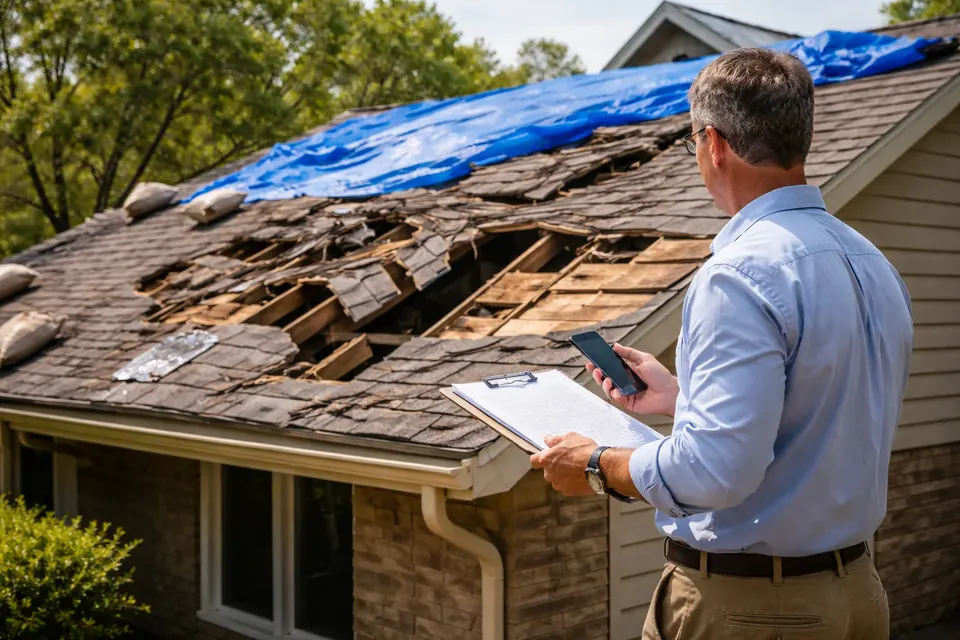
After a hail or windstorm, most San Marcos property owners meet one adjuster: the person the insurance company sends. Some later bring in a second one, a public adjuster, and wonder how the two fit together. The difference between a public adjuster vs. an insurance adjuster comes down to a simple question: who does each one work for? This guide gives a practical, side-by-side look at both roles on a typical Central Texas storm claim, including how each is paid, what each does, and the Texas rules that apply.
We are a San Marcos public adjuster, so we have an interest in this topic, and we will say that up front. Our goal here is to explain the roles clearly so you can decide what your claim needs. Plenty of claims are resolved fairly without a public adjuster. If you want a broader overview of the different adjuster types, see What Is a Public Claims Adjuster?
Who each adjuster works for
The insurance adjuster works for the insurance company. That person might be a staff adjuster employed by the insurer or an independent adjuster the insurer hires on contract, which is common after large storms when claim volume spikes. Either way, the insurer assigns them, directs their work, and relies on their findings to decide the claim. Their role is to investigate the loss, apply the policy, and write an estimate for the company.
The public adjuster works for you, the policyholder. You choose whether to hire one, and the relationship is set out in a written contract. A public adjuster documents the damage, reviews the policy, prepares an estimate of the loss, presents the claim to the insurer, and handles communication on your behalf. Texas requires public adjuster contracts to state plainly, "WE REPRESENT THE INSURED ONLY."
Neither role is inherently good or bad. Many insurance adjusters are careful and fair. The point is that each one has a different client, and that shapes what they focus on.
How each is paid
The insurer pays its own adjusters through salary, per-claim fees, or contract arrangements. You never receive a bill from the insurance company’s adjuster.
A public adjuster is paid by the policyholder, usually as a percentage of the claim payment. Texas law limits that compensation to no more than 10% of the insurance settlement on the claim (Texas Insurance Code §4102.104). There is an important exception: if the insurer pays, or commits in writing to pay, the policy limits within 72 hours after the loss is reported, the public adjuster cannot take a percentage fee and is limited to reasonable hourly compensation. Fees are disclosed in a written contract before any work begins.
Side-by-side comparison
| Insurance adjuster (staff or independent) | Public adjuster | |
|---|---|---|
| Works for | The insurance company | The policyholder |
| Who chooses them | The insurer assigns them | You decide whether to hire one, and whom |
| How paid | By the insurer | By the policyholder, under a written contract; capped at 10% of the settlement in Texas |
| Main job | Investigate, apply the policy, recommend payment | Document, estimate, and present the claim; negotiate for the policyholder |
| Writes an estimate | Yes, for the insurer | Yes, for the policyholder |
| Decides the claim | Recommends; the insurer decides | No; presents and negotiates |
| Texas licensing | Generally licensed by TDI under separate adjuster rules | Licensed by TDI under Insurance Code Chapter 4102 |
| Contract with you | None | TDI-approved terms; 72-hour right to rescind |
| Can do repairs | Not their role | Prohibited on claims they adjust |
| Legal advice | No | No; refers legal questions to an attorney |
What each adjuster actually does on a claim
The insurance adjuster’s duties
- Contacts you after the claim is reported and schedules an inspection.
- Inspects the property and takes photos and measurements.
- Reviews the policy, including deductibles, exclusions, and endorsements.
- Writes an estimate, often in Xactimate, and may request engineer or specialist reports.
- Requests information from you, such as photos, receipts, or a proof of loss.
- Recommends whether and how much the insurer should pay.
The public adjuster’s duties
- Reviews your policy and explains, in plain terms, what coverages and limits may apply.
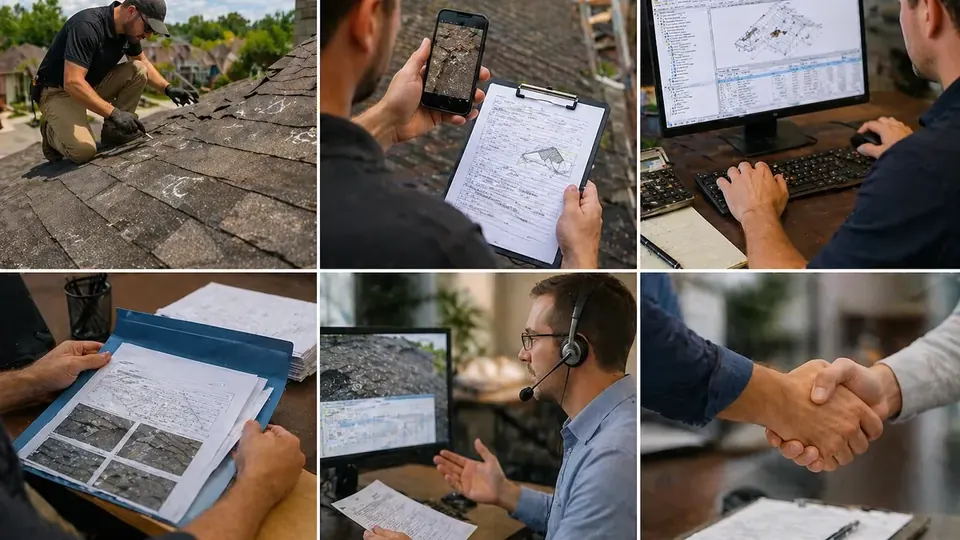
- Inspects and documents the damage independently, including interior, exterior, and contents where relevant.
- Prepares a detailed estimate of the loss.
- Answers the insurer’s information requests and keeps the file organized.
- Meets the insurer’s adjuster on site and discusses differences in scope or price.
- Prepares supplements and, where the policy allows and you choose it, helps with the appraisal process.
How they interact on a San Marcos hail or wind claim
Storm claims are where this comparison matters most for local owners. The NOAA Storm Events Database lists 180 hail reports and 109 thunderstorm wind reports in Hays County, with hail peaking in May and April. Hays County is not in the TWIA catastrophe area, so most San Marcos properties carry wind and hail coverage through their regular homeowners or commercial insurer. Here is how a typical claim might unfold when both adjusters are involved.

- The storm and the report. After an event like the May 9, 2024 storm, when NWS recorded 2.5-inch hail near the San Marcos outlet mall and 70 mph gusts that damaged roofs (NOAA NCEI event record), you report the claim to your insurer.
- The insurer’s inspection. The insurer assigns a staff or independent adjuster, who inspects the roof and exterior and writes an estimate.
- Hiring a public adjuster (optional). You may hire a public adjuster before or after that inspection. Once hired, the public adjuster notifies the insurer in writing and becomes your point of contact.
- Joint or follow-up inspection. The two adjusters often meet on the roof. The public adjuster points out damage, measurements, and items the first estimate did not include, such as damaged metal roof panels, flashing, vents, gutters, screens, or HVAC fins.
- Estimate comparison. The public adjuster submits a detailed estimate and supporting photos. The insurer’s adjuster reviews it and may revise the insurer’s estimate, request more information, or explain disagreements.
- Resolution. Most claims end with a negotiated scope and payment. If the disagreement is only about the amount of covered loss, the policy may allow appraisal. If coverage itself is disputed, an attorney may be needed.
Throughout, the insurer still controls the decision and must follow Texas Prompt Payment rules in Insurance Code Chapter 542. Hiring a public adjuster does not change those deadlines, and it does not guarantee a higher payment.
Local roof details that often come up
San Marcos subdivisions are dominated by composition shingle roofs, while standing-seam and exposed-fastener metal roofs are common on Hill Country homes, barns, and outbuildings west of I-35. Each raises different questions on a storm claim. Shingle roofs bring up hail-hit counts, test squares, and accessories. Metal roofs often turn on whether dents are treated as covered damage or as cosmetic under a policy endorsement. Reading the policy language for those details is a shared task: the insurer’s adjuster applies it, and a public adjuster can explain it to you and respond to it.
Texas rules for public adjusters (Chapter 4102)
Public adjusters in Texas are licensed and regulated by the Texas Department of Insurance under Texas Insurance Code Chapter 4102. Key protections for policyholders include:
- Licensing. A public adjuster must hold a Texas public adjuster license. You can verify a license through TDI. Ours is #3356839, held through Rise Public Adjusting LLC.
- Written contract on approved terms. The contract must use TDI-approved terms and display "WE REPRESENT THE INSURED ONLY."
- 72-hour right to rescind. You may cancel within 72 hours of signing.
- Fee cap. Compensation may not exceed 10% of the insurance settlement, with the 72-hour policy-limits exception described above.
- No repair work. A public adjuster may not take part in repairing or rebuilding the property on a claim they adjust. Texas law also does not allow your contractor to act as your public adjuster.
Questions to ask before you decide
Whether you are talking with the insurer’s adjuster or interviewing a public adjuster, a few direct questions can tell you a lot about how the claim will be handled.
For the insurance company’s adjuster
- Are you a staff adjuster or an independent adjuster, and who is your supervisor?
- What parts of the damage are included in your estimate, and what was left out or is still under review?
- What information do you still need from me to make a decision?
- Will an engineer or other specialist be involved, and may I have a copy of any report you rely on?
For a public adjuster you are considering
- What is your Texas public adjuster license number, and may I verify it with TDI?
- What is your fee, and how is it calculated on payments already made?
- Who will actually inspect the property and communicate with the insurer?
- How will you keep me informed, and how do I reach you?
A reputable San Marcos public adjuster should answer these plainly and put the fee in writing before any work begins. Our guide on how to find a public adjuster covers more questions to ask.
Which one do you need?
You will always deal with the insurance adjuster. The real question is whether you also want someone working only for you. Many owners handle small, straightforward claims themselves. A public adjuster is more often worth considering when the damage is large or complicated, the estimate seems to leave out obvious work, the claim has stalled, or you simply do not have time to manage the process. Our guide Do I Need a Public Adjuster? walks through that decision, and our hail damage claims and wind damage claims pages explain how we handle storm losses.
If you would like a no-cost opinion on where your claim stands, a San Marcos public adjuster can look over your policy and the insurer’s estimate. Request a Free Claim Review or call +1 (832) 503-5866. We serve San Marcos, Hays County, and surrounding Central Texas communities.
Frequently Asked Questions
Is the insurance adjuster on my side?
The insurance company’s adjuster, whether a staff employee or an independent adjuster the company hired, works for the insurer. Many are professional and fair, but their job is to evaluate the claim for the company under the policy. A public adjuster is hired by and represents the policyholder.
Do I have to pay the insurance company’s adjuster?
No. The insurer pays its own adjusters. You pay a public adjuster only if you choose to hire one, under a written contract. In Texas, public adjuster compensation may not exceed 10% of the insurance settlement on the claim.
Will the insurer still send its own adjuster if I hire a public adjuster?
Yes. Hiring a public adjuster does not replace the insurer’s adjuster. The insurer still investigates and decides the claim. The public adjuster documents the loss for you, presents the claim, and communicates with the insurer’s adjuster on your behalf.
Can I cancel a public adjuster contract in Texas?
Texas public adjuster contracts must allow the policyholder to rescind within 72 hours of signing. The contract must also use terms approved by the Texas Department of Insurance and state that the adjuster represents the insured only.
Can my public adjuster also replace my roof?
No. Under Texas Insurance Code Chapter 4102, a public adjuster may not participate in the repair or reconstruction of property on a claim they are adjusting. You choose your own contractor separately.
Is a public adjuster the same as an attorney?
No. Public adjusters handle the claim itself: documentation, estimates, and negotiation with the insurer. They cannot give legal advice or file lawsuits. If your claim involves a lawsuit, bad faith, or a deadline to sue, talk with a Texas attorney.
Sources and further reading
This article is general information about property insurance claims in Texas, not legal advice, and not a promise of any coverage or outcome. Your policy language and the facts of your loss control your claim.