

Key takeaways
- There are three common kinds of property claim adjusters: staff adjusters and independent adjusters, who work for the insurer, and public adjusters, who work for the policyholder.
- A public claims adjuster is the only one of the three you hire and the only one whose Texas contract must say “WE REPRESENT THE INSURED ONLY.”
- Day to day, a public claims adjuster reads the policy, documents the damage, writes the estimate, tracks deadlines, and negotiates the details with the insurer’s adjusters.
- Knowing the vocabulary (scope, ACV, recoverable depreciation, supplement, reservation of rights) makes any claim easier to follow, with or without professional help.
Once a claim is open, the word “adjuster” starts showing up everywhere: a field adjuster, a desk adjuster, an independent adjuster, a CAT adjuster. It is easy to lose track of who is who. So what is a public claims adjuster, and how is that person different from everyone else working your file? This article lays out the three main types of adjusters side by side, then walks through what a public claims adjuster actually does on a claim from week to week, and finishes with a short glossary of the terms you are most likely to see in your paperwork.
If you already know you want help and are mainly wondering about the hiring steps, start with What Is a Public Adjuster and How to Hire One. This piece is about roles and terminology.

The three kinds of property claim adjusters
Every property insurance claim is evaluated by someone working for the insurer. Sometimes that is an employee of the company; sometimes it is an outside adjuster the company hires. A public adjuster is a third, optional role that the policyholder brings in.
Staff adjusters
A staff adjuster (sometimes called a company adjuster) is an employee of the insurance company. They handle claims under the company’s guidelines, use the company’s estimating standards, and report to the company’s claims managers. Some staff adjusters inspect in the field; others work as desk adjusters reviewing files remotely.
Independent adjusters
An independent adjuster is not an insurer employee. They are usually hired by the insurer, often through an adjusting firm, to handle claims under contract. Insurers lean on independent adjusters heavily after large storms, when claim volume jumps. The name causes confusion: “independent” describes the employment arrangement, not whose side they are on. Their client is the insurance company that assigned the claim.
Public adjusters
A public adjuster, or public claims adjuster, is licensed to represent the policyholder. You choose them, sign a contract with them, and pay them under the terms of that contract. In Texas, public adjusters are licensed and regulated by the Texas Department of Insurance under Insurance Code Chapter 4102.
Staff vs. independent vs. public adjusters compared
| Question | Staff adjuster | Independent adjuster | Public claims adjuster |
|---|---|---|---|
| Who hires them? | The insurance company (as an employee) | The insurance company (as a contractor, often through a firm) | The policyholder |
| Whose interests do they represent? | The insurer | The insurer | The policyholder only |
| Who pays them? | The insurer, through salary | The insurer or adjusting firm, often per claim | The policyholder, under a written contract |
| Texas licensing | Works under the insurer’s claims operation | TDI adjuster license | TDI public adjuster license (Chapter 4102) |
| Cost to you | None directly | None directly | Fee set in contract; capped at 10% of the settlement in Texas |
| Typical involvement | Every claim handled in-house | Often after storms or in high-volume periods | Only when you choose to hire one |
| Writes an estimate? | Yes, for the insurer | Yes, for the insurer | Yes, for you, to support your claim |
| Required contract language | Not applicable | Not applicable | “WE REPRESENT THE INSURED ONLY” |
None of this means insurer-side adjusters act in bad faith. Many are experienced and conscientious. The point is structural: two of the three roles are paid to evaluate the claim for the company, and only one is paid to present it for you. For a deeper look at how that plays out on a single claim, see Public Adjuster vs. Insurance Adjuster.
What a public claims adjuster does day to day
The job is less dramatic than “taking on the insurance company.” Most of it is careful, detailed work that makes the claim hard to underpay by accident. Here is what that usually looks like across the life of a claim.
Intake and policy review
The first task is reading the policy, all of it. That includes the declarations page (limits and deductibles), the coverage forms, and every endorsement. In Central Texas, wind and hail deductibles are frequently written as a percentage of the dwelling limit, and some roof coverage is settled on actual cash value or a payment schedule. Those details shape the entire claim, so they come first.
Inspection and documentation
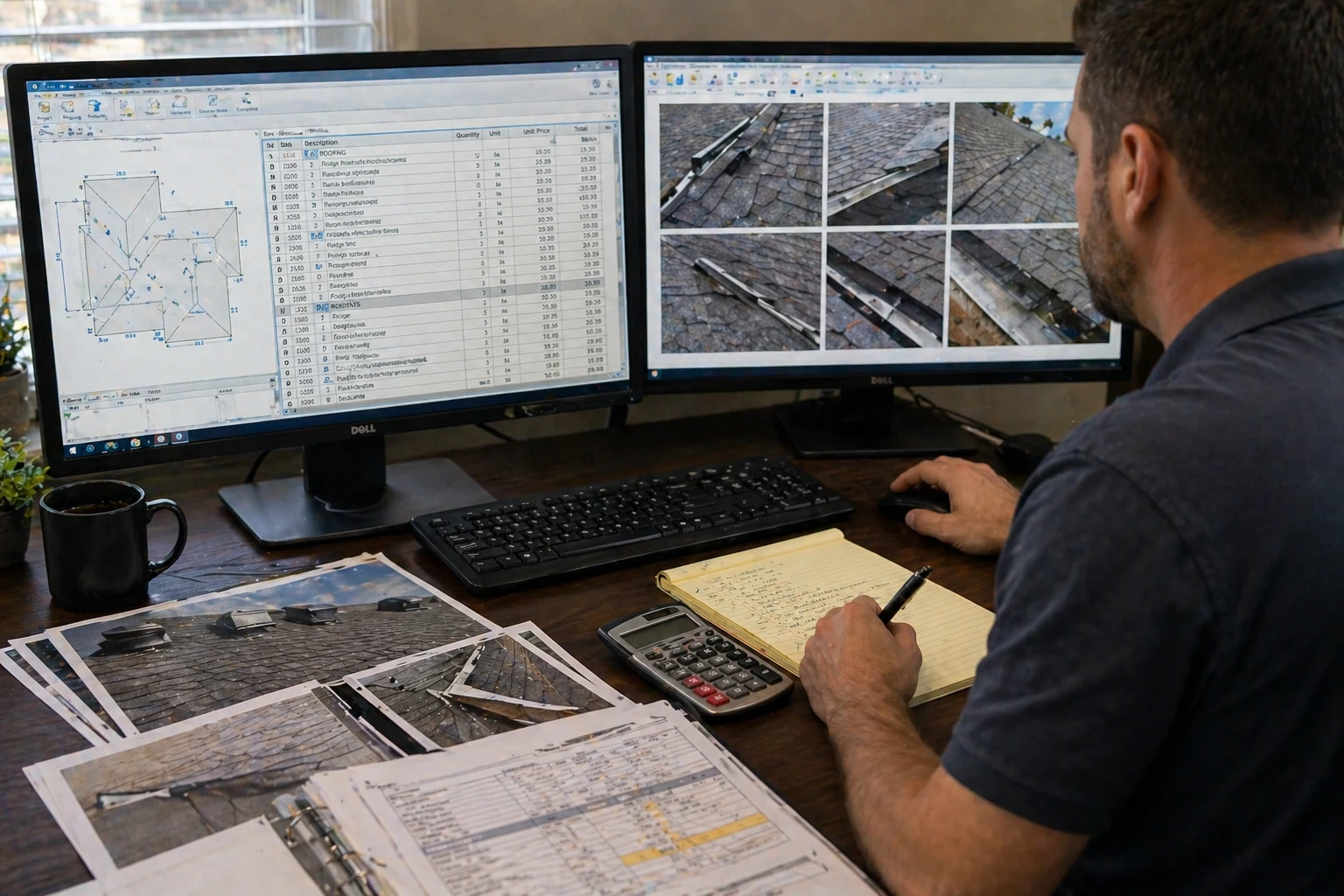
Next comes a thorough inspection: roof slopes, gutters, vents, windows, siding, fences, interior ceilings and walls, attic spaces, and anything else the loss touched. Each item is photographed and measured. On interior losses, tools such as moisture meters and Matterport 3D imaging can help show the full extent of damage. On a Hill Country metal roof or an older home near downtown San Marcos, the materials and construction details matter as much as the damage itself.
Estimating
The documentation becomes a line-item estimate, usually in Xactimate, which lists every task needed to restore the property: tear-off, underlayment, flashing, drip edge, paint, trim, debris removal, and so on. A complete estimate also considers whether building code items apply. The City of San Marcos currently enforces the 2021 International Codes, in effect since April 1, 2023, though code upgrades are only paid when your policy includes ordinance or law coverage. Our local building codes page explains more.
Submitting and communicating
The public adjuster sends the estimate and supporting documents to the insurer, then becomes the main point of contact with the insurer’s field and desk adjusters. That includes scheduling re-inspections, answering requests for information, and keeping a written record of every conversation.
Tracking deadlines
Texas’s Prompt Payment of Claims law sets timeframes for insurers to acknowledge a claim, request information, accept or reject, and pay. Policies also set deadlines of their own, such as the window to complete repairs and collect recoverable depreciation. A public claims adjuster keeps a calendar of these dates so nothing slips. (Deadlines to file a lawsuit are a legal matter; that question belongs with a Texas attorney.)
Reviewing the insurer’s estimate
When the insurer’s estimate arrives, the public adjuster compares it line by line with the documented damage. Common gaps include missing roof slopes, skipped accessories, low quantities, or interior rooms left out entirely. Each gap is raised with supporting photos and measurements. You can see what this review involves on our insurance estimate review page.
Supplements and payment follow-up
Hidden damage often turns up once repairs begin, such as rotted decking under shingles or wet insulation behind drywall. A public adjuster documents those items and submits them as supplements. They also follow up on payments, including recoverable depreciation once repairs are complete, and help sort out checks that name a mortgage company.
Appraisal support
If you and the insurer agree damage is covered but disagree on the amount, many policies allow either side to demand appraisal. A public adjuster can help you understand that process and prepare the documentation behind it. Our insurance appraisal page covers how it works.
Claim terminology: a short glossary
Whether you hire help or not, these terms show up constantly in claim letters and estimates. Knowing them makes the process far less confusing.
| Term | What it means |
|---|---|
| Field adjuster | The adjuster who visits and inspects the property in person. |
| Desk adjuster | An adjuster who reviews the file, photos, and estimate from an office and often approves payment. |
| CAT adjuster | Short for catastrophe adjuster; usually an independent adjuster deployed after a large storm. |
| Scope | The list of damaged items and repair tasks the estimate includes. |
| Replacement cost value (RCV) | The cost to repair or replace damaged property with like kind and quality, without deducting for age. |
| Actual cash value (ACV) | Replacement cost minus depreciation. Many insurers pay ACV first. |
| Recoverable depreciation | The withheld depreciation a replacement-cost policy may pay after repairs are completed, often within a policy deadline. |
| Supplement | A request to add items or costs to an existing claim, often for damage found during repairs. |
| Proof of loss | A sworn statement of the amount claimed, which some insurers request within a set time. |
| Reservation of rights | A letter saying the insurer is investigating but reserving its right to deny coverage later. |
| Overhead and profit (O&P) | Allowances for a general contractor’s costs and margin when a repair requires coordinating multiple trades. |
| Appraisal | A policy process for resolving disagreements over the amount of loss, using two appraisers and an umpire. |
For a closer look at the RCV and ACV split, read Replacement Cost vs. Actual Cash Value in Texas.
Why the distinction matters in San Marcos
Hays County sees a lot of claim activity. NOAA’s Storm Events Database records 180 hail reports and 109 thunderstorm wind reports in the county, along with repeated flash flooding along the Blanco and San Marcos Rivers. After a large event, insurers often bring in independent CAT adjusters from out of state to handle the surge. Those adjusters may not know local construction, such as standing-seam metal roofs in the Hill Country, slab foundations on expansive clay east of I-35, or multifamily properties near Texas State University.
That is not a criticism; it is just the reality of high-volume claim seasons. It is also why many property owners look for a public adjuster in San Marcos who knows the area. A San Marcos public adjuster works for one party only, the policyholder, and can spend the time a busy CAT adjuster may not have.
Is a public claims adjuster right for your claim?
It depends on the size of the loss, how the claim is going, and how much time you can give it. Small claims that are handled quickly and fairly often do not need outside help. Larger, disputed, or stalled claims are where a public adjuster in San Marcos is more commonly considered. Our article Do I Need a Public Adjuster? walks through that decision in detail, and How to Find a Public Adjuster covers vetting one.
If you would like a second opinion on where your claim stands, our San Marcos public adjuster service offers a Free Claim Review. Fees are disclosed in a written contract before any work begins; Texas law caps public adjuster compensation at 10% of the insurance settlement. Call +1 (832) 503-5866 or email info@sanmarcospublicadjuster.com.
Frequently Asked Questions
Is a public claims adjuster the same as a public adjuster?
Yes. “Public claims adjuster,” “public insurance adjuster,” and “public adjuster” all describe the same role: a licensed adjuster who represents the policyholder rather than the insurance company. In Texas the license is issued by the Texas Department of Insurance under Insurance Code Chapter 4102.
Who does an independent adjuster work for?
An independent adjuster is hired by the insurance company, often through an adjusting firm, to handle claims on the insurer’s behalf. The word “independent” means they are not an employee of the insurer, not that they are independent of it. Their client is still the insurance company.
What is a desk adjuster?
A desk adjuster works the claim from an office, reviewing photos, estimates, and reports rather than visiting the property. Many claims involve both a field adjuster who inspects and a desk adjuster who reviews and approves the estimate.
Can a public claims adjuster talk to my insurer for me?
Yes. Once you sign a contract, your public adjuster typically notifies the insurer in writing and handles most claim communication. You remain the policyholder and can still communicate with your insurer directly.
Does every claim need three adjusters?
No. Every claim has at least one adjuster working for the insurer, either staff or independent. A public adjuster is only involved if you choose to hire one, which many people do on larger, disputed, or delayed claims.
Sources and further reading
This article is general information about property insurance claims in Texas, not legal advice, and not a promise of any coverage or outcome. Your policy language and the facts of your loss control your claim.