
Key takeaways
- NOAA records list 109 thunderstorm wind reports and 31 tornado reports for Hays County; wind reports peak in May and June.
- Documented local events include 70–80 mph winds that tore metal roofs off buildings along I-35 in San Marcos (2007) and a 75 mph gust that peeled a metal roof off a San Marcos house (2019).
- Hays County is not in the TWIA area, so wind coverage usually comes from your regular homeowners or commercial policy.
- Many Texas policies have a separate, percentage-based wind/hail deductible. Check your declarations page.
- Fallen-tree coverage depends on what the tree damaged; removal of a tree that hits nothing covered is often limited or excluded.
- Dated photos, a specific date of loss, and prompt mitigation are the foundation of a strong wind claim.
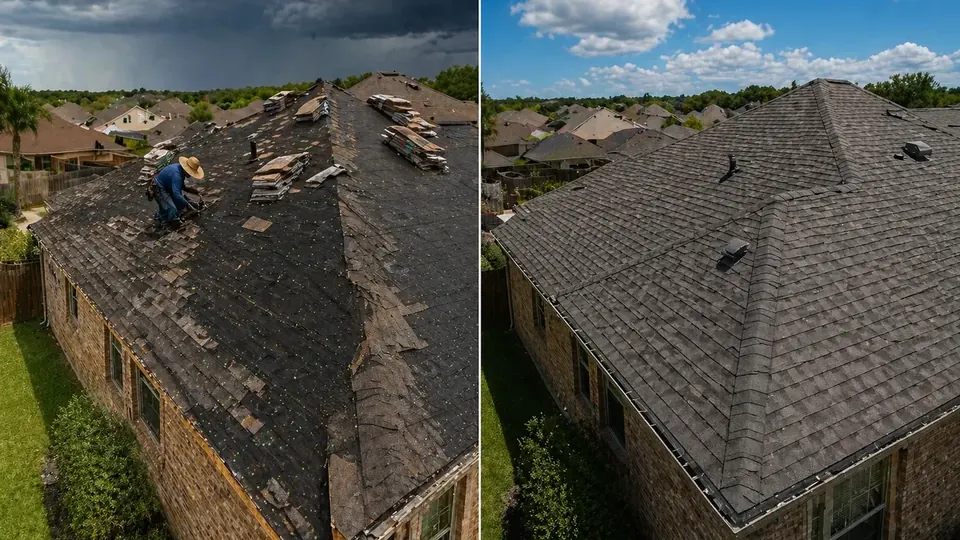
Most people picture hail when they think of Central Texas storms, but wind does just as much damage to San Marcos homes and businesses. Straight-line gusts from a passing thunderstorm can lift shingles, peel back metal roofing, rip off siding, and drop a heavy oak limb through a roof in seconds. This guide explains how wind damage insurance claims work in San Marcos, TX: what the local storm record shows, how your deductible and policy handle wind, what happens when a tree falls, and how to document the loss so your claim starts on solid ground.
Wind and tornado history in Hays County
The NOAA National Centers for Environmental Information (NCEI) Storm Events Database lists 109 thunderstorm wind reports for Hays County. Most come from spring and early summer storms, the same systems that bring hail.
| Month | Thunderstorm wind reports |
|---|---|
| March | 12 |
| April | 13 |
| May | 35 |
| June | 25 |
| July | 5 |
| August | 7 |
| September–February (combined) | 12 |
| Total | 109 |
May and June together account for more than half of the reports. Winter is not off the table, though. Two of the most damaging wind events in San Marcos happened in January.
Notable straight-line wind events
Straight-line winds, including downbursts, are strong winds that rush out of a thunderstorm and spread along the ground. They do not rotate like a tornado, but gusts of 70 mph or more can do comparable damage to roofs and trees. These Hays County events come directly from NCEI records:
| Date | Location | Estimated gust | Damage noted by NCEI |
|---|---|---|---|
| Jan 13, 2007 | San Marcos, along I-35 | 70–80 mph | Tin metal roofs torn off several buildings and tossed several hundred feet; damage to roofs and eaves |
| Apr 25, 2007 | Southern Hays County | Spotty gusts near 80 mph | Bow-shaped line of storms; mostly knocked-over trees |
| May 4, 2018 | Fitzhugh | About 80 mph | Part of a metal roof peeled off a barn-type structure; trusses knocked off posts |
| Jun 9, 2019 | San Marcos | About 75 mph | Metal roof partially peeled off a house |
| Jun 9, 2019 | Niederwald | About 80 mph | Large section of a roof blown off a house |
| Jan 10, 2020 | Kyle | About 75 mph | Siding blown off a house; trees and fences down; multiple houses with shingle damage |
| May 9, 2024 | San Marcos | About 70 mph | Trees down; church roof damaged (same storm brought large hail) |
| May 9, 2026 | Buda | About 70 mph | 6–12 inch oak limbs snapped |
Notice how often metal roofs appear. Exposed-fastener and standing-seam metal is common on Hill Country homes, barns, and commercial buildings around San Marcos, and once wind gets under an edge or a loose panel, it can peel back long sections at once.
Tornadoes in and near San Marcos
Hays County has 31 tornado reports in the NCEI database. Most were brief and rated EF0 or EF1, but even a weak tornado can damage roofs, carports, and outbuildings along a narrow path. Recent examples include:
- October 30, 2015: an EF1 tornado formed near Centerpoint Rd. and Old Zorn Rd. in Guadalupe County and tracked about 2.25 miles north-northeast into Hays County on the San Marcos side, causing minor roof damage to homes where it formed.
- February 19, 2017: an EF1 tornado near Wimberley snapped trees and caused considerable structural damage to a small business; an EF0 near Niederwald the same day destroyed an aluminum barn and damaged a carport.
- June 12, 2025: two EF0 tornadoes south of Wimberley, with maximum winds estimated at 80 mph, caused tree damage and minor structural damage.
- January 13, 2007: an F1 tornado near the San Marcos Police Headquarters, part of the same storm that brought damaging straight-line winds along I-35.
For the full local record, see our San Marcos storm history page. If you live in the Wimberley area, our Wimberley service area page has local details as well.
Common types of wind damage
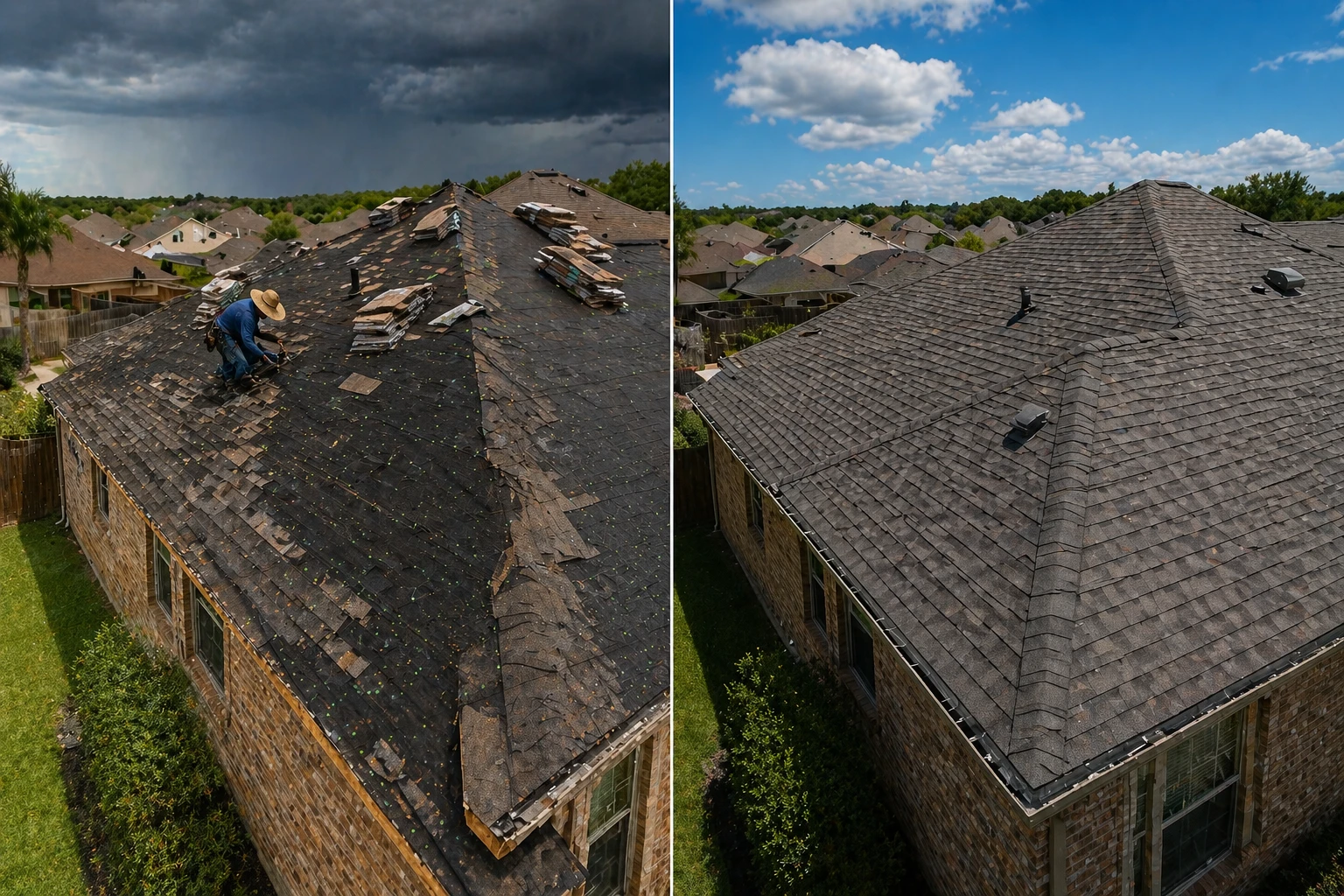
Wind damage is not always obvious from the driveway. The table below lists what we commonly look for after a wind event, and why each item matters to a claim.
| Component | What wind damage can look like | Why it matters |
|---|---|---|
| Shingle roof | Missing tabs, creased or lifted shingles, broken seal strips | Creased or unsealed shingles may not be visible from the ground but can fail in the next storm |
| Metal roof | Peeled or loose panels, pulled fasteners, bent trim and ridge caps | Matching panel profile and color can affect the scope of repair |
| Flat/low-slope commercial roof | Lifted membrane, displaced flashing or coping | Small openings can let water into insulation and the deck |
| Siding, soffit, fascia | Panels blown off, cracked fiber-cement, loose trim | Discontinued materials can raise matching questions |
| Fences, carports, outbuildings | Leaning or flattened sections, torn metal roofing | Often covered under "other structures," with its own limit |
| Interior | Ceiling stains, wet insulation, damaged drywall after rain | Interior water damage usually must follow an opening created by wind to be covered |
How your policy handles wind damage claims in San Marcos
No TWIA in Hays County
Coastal Texas counties rely on the Texas Windstorm Insurance Association for windstorm coverage. Hays County is not in that area. For San Marcos, Kyle, Buda, and Wimberley, wind coverage normally sits inside your regular homeowners or commercial property policy, or the Texas FAIR Plan in some cases. That also means TDI windstorm (WPI-8) certification rules for the coast do not apply here.
The wind/hail deductible
Many Texas policies carry a separate deductible for wind and hail, often a percentage of the dwelling limit. On a $300,000 Coverage A limit, a 1% deductible is $3,000 and a 2% deductible is $6,000. Some policies also include roof payment schedules or actual cash value (ACV) roof endorsements that reduce payment on older roofs. Check your declarations page, and see our guide to replacement cost vs. actual cash value if you are unsure how your roof will be valued.
Rain that follows the wind
Many policies cover interior water damage from rain only if wind or hail first created an opening in the roof or walls. That makes it important to document the opening itself, such as missing shingles or a peeled panel, alongside the stained ceiling.
When a tree falls: what is usually covered
Fallen trees are one of the most common wind claims around San Marcos, where mature live oaks, elms, and cedars shade many older neighborhoods and Hill Country lots. Coverage depends on what the tree hits and on your policy wording, but the general pattern looks like this:
- Tree hits the house or a covered structure. Damage to the structure is typically covered as a wind loss, subject to the deductible. Many policies also pay a limited amount to remove the tree from the structure.
- Tree hits a fence, shed, or detached garage. Usually handled under "other structures" coverage, which has its own limit.
- Tree falls in the yard and hits nothing covered. Removal is often not covered, or covered only in narrow situations described in the policy, such as a tree blocking a driveway.
- Neighbor's tree hits your home. Your own policy usually handles damage to your property. Questions about a neighbor's responsibility are liability questions; talk with your insurer or a Texas attorney.
Before cutting anything, photograph the tree where it landed, the root ball or broken trunk, and the damage underneath. Then take reasonable steps to prevent further damage, like tarping, and keep every receipt.
How to document a wind damage claim
- Pin down the date of loss. Note when the wind hit. Our storm lookup tool can help you match your address and date to official reports.
- Photograph everything before cleanup. Wide shots of each side of the building, then close-ups. Capture debris in the yard, too; shingles and panels on the ground tell a story.
- Protect the property. Tarp roof openings and board windows if it is safe. Most policies require reasonable steps to prevent further damage.
- Save damaged materials when practical. A few pieces of torn shingle or panel can help show the type and age of the materials.
- Report the claim promptly and keep a written log of calls, emails, and inspection dates.
- Keep receipts for emergency repairs, tree work, and any extra living expenses if the home is not livable.
Our claim documentation checklist walks through these steps in more detail.
Wind damage claim steps after the inspection
After you report the claim, the insurer will usually send an adjuster to inspect and then issue an estimate. Under the Texas Prompt Payment of Claims Act, insurers generally must acknowledge a claim and begin their investigation within 15 days of notice, and accept or reject it within 15 business days after receiving the information they requested, with extensions available in some situations, including declared weather catastrophes. The Texas Department of Insurance has more on what to expect.
Compare the insurer's estimate line by line against what you documented. Wind claims are often underpaid because the scope covers only the most visible spots, overlooks creased shingles or loose fasteners, or ignores matching issues on siding and metal panels. If the numbers do not add up, you can provide additional documentation, request a reinspection, or ask about the appraisal clause for disputes over the amount of loss. Our page on underpaid insurance claims covers those options.
How a San Marcos public adjuster can help
A licensed San Marcos public adjuster represents you, the policyholder, rather than the insurance company. For a wind claim, that can mean reviewing your policy and deductible, inspecting the full property, building a detailed estimate, and handling communication with the carrier so you can focus on repairs. We cannot guarantee a result; every claim depends on the damage and the policy terms. Fees are disclosed in a written contract before any work begins, and Texas law caps public adjuster compensation at 10% of the insurance settlement.
Learn more about our wind damage claims service, or if hail came with the wind, read our breakdown of San Marcos hail season. When you are ready, request a free claim review. As a San Marcos Public Adjuster serving San Marcos, Hays County, and surrounding Central Texas communities, we will give you an honest read on where your claim stands.
Frequently Asked Questions
Does homeowners insurance cover wind damage in San Marcos?
Most Texas homeowners and commercial property policies cover direct physical damage caused by wind, subject to the deductible, exclusions, and limits in the policy. Because Hays County is outside the TWIA area, wind coverage usually comes from your regular insurer rather than a separate windstorm policy. Check your declarations page and policy form to confirm.
What is a wind/hail deductible?
It is a separate deductible that applies to wind and hail losses. In Texas it is often a percentage of your dwelling (Coverage A) limit, such as 1% or 2%, rather than a flat dollar amount. A 2% deductible on a $300,000 dwelling limit is $6,000.
Will insurance pay to remove a tree that fell in my yard?
It depends on what the tree hit and on your policy. When a tree damages a covered structure, the damage to the structure is typically covered, and many policies include some limited coverage for debris removal. A tree that falls without damaging anything covered may not be covered for removal. Read the debris removal and trees provisions in your policy.
My neighbor's tree fell on my house. Whose insurance pays?
In many cases, your own policy responds to damage to your property, regardless of where the tree came from. Whether a neighbor could be responsible usually depends on facts such as whether the tree was obviously dead or diseased. That is a liability question best discussed with your insurer or a Texas attorney.
How do I prove wind caused the damage?
Start with dated photos of the damage and debris, then match your date of loss to official weather records such as NOAA storm reports and nearby wind observations. Patterns of damage, like shingles lifted on the windward side or creased tabs, also help an inspector distinguish wind damage from wear.
Can a public adjuster help with a wind damage claim in San Marcos?
Yes. A licensed public adjuster represents the policyholder, can document and estimate the damage, review the policy, and communicate with the insurer on your behalf. Results depend on the policy and the facts, and no outcome is guaranteed.
Sources and further reading
This article is general information about property insurance claims in Texas, not legal advice, and not a promise of any coverage or outcome. Your policy language and the facts of your loss control your claim.